
Table of Contents
BDA/DAS Systems: Essential for Emergency Responder Radio Coverage
Modern buildings often block radio signals, but a BDA/DAS system is the key to restoring reliable in-building coverage. A bi-directional amplifier (BDA) captures weak outdoor public safety radio signals and amplifies them, while a distributed antenna system (DAS) distributes the strengthened signal throughout the facility, eliminating dead zones and ensuring seamless communication. This combination forms an in-building signal enhancement system that is critical for emergency responder radio coverage.
Fire and building codes, including the International Fire Code (IFC) and NFPA 72, now require adequate radio coverage for first responders. Additionally, Federal Communications Commission (FCC) Part 90 regulations mandate that public safety communications remain functional inside structures. According to the FCC, these rules help ensure that police, fire, and EMS personnel can stay connected during emergencies. To meet these standards, BDA/DAS equipment must be listed to UL 2524, a safety and performance standard established by Underwriters Laboratories (UL). This listing ensures that components have been rigorously tested for reliability and installation integrity.
By amplifying and distributing signals, these systems extend the reach of handheld and mobile Two Way Radio devices. First responders’ Two Way Radio communication remains clear and continuous, even in basements, stairwells, and other traditionally difficult areas.
After installation, BDA/DAS systems must be verified for ERCES compliance through grid testing to confirm that signal strength meets code requirements. At White Cloud Communications Inc., we design and install BDA/DAS solutions that help property owners meet these regulations, providing the expertise needed to achieve and maintain reliable emergency responder radio coverage. Our team supports every step, from consultation to final verification.
Fundamentals of BDA/DAS and Emergency Communication Networks
Understanding the bda das system is essential for reliable emergency communications in commercial and institutional buildings where concrete, steel, and low-E glass often block radio signals. A Bi-Directional Amplifier (BDA) boosts existing two-way radio frequencies to improve in-building penetration, while a Distributed Antenna System (DAS) distributes signals from a central source across multiple antennas for wide-area coverage. Together, this bi-directional amplifier and distributed antenna system technology forms the foundation of ERCES, the code-mandated in-building radio coverage that first responders rely on during emergencies. Both technologies are critical to Emergency Responder Radio Coverage Systems (ERCES) mandated by NFPA and IFC fire codes to protect first responders operating inside structures.
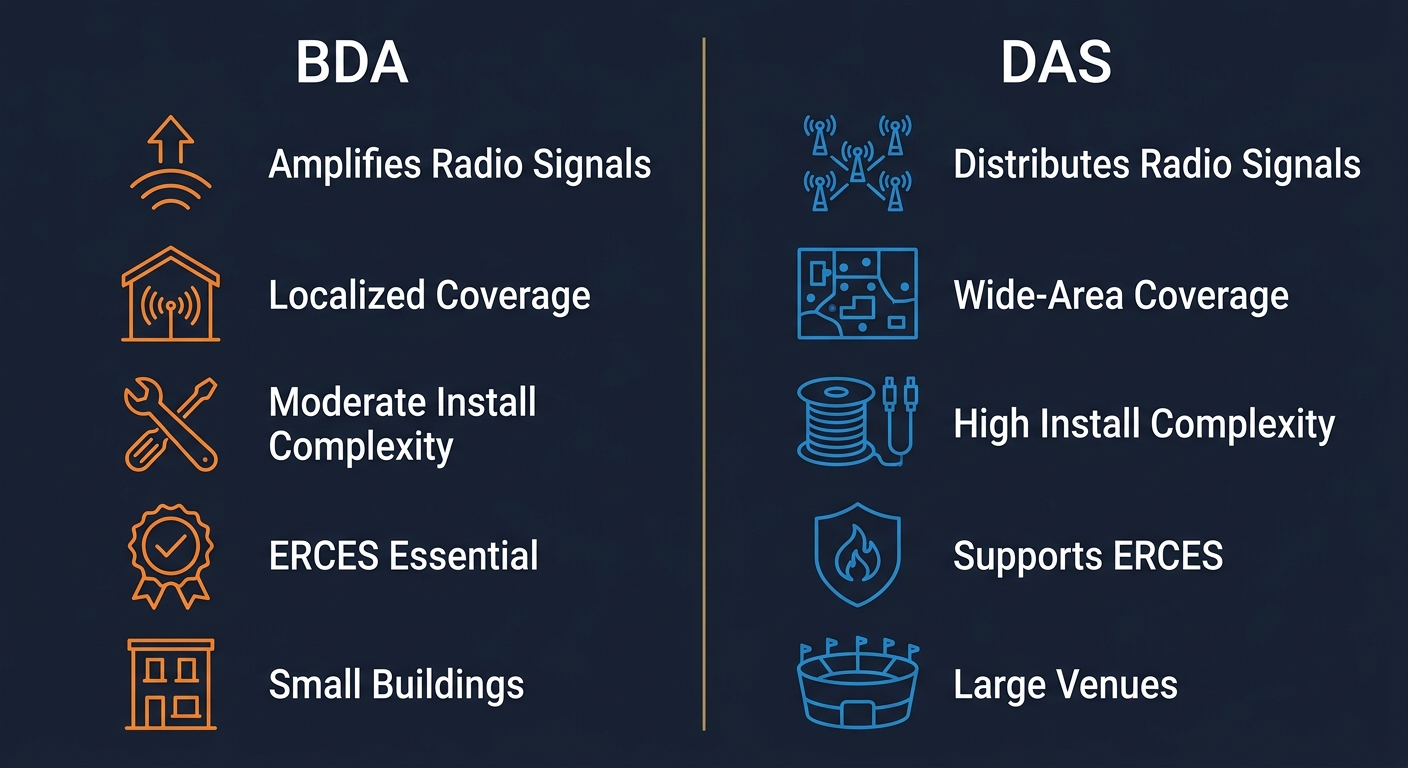
The following table highlights the key functional and regulatory differences between BDA and DAS components.
| Feature | BDA | DAS |
|---|---|---|
| Primary Function | Amplifies radio signals | Distributes radio signals |
| Coverage Area | Localized signal boosting | Wide-area signal distribution |
| Installation Complexity | Moderate | High |
| Regulatory Compliance | Essential for ERCES | Supports extensive coverage |
| Typical Use Case | Small to mid-size buildings | Large campuses, stadiums |
Proper installation and code verification demand the expertise of BDA System Specialists who understand the intricacies of signal propagation and regulatory requirements. Our team ensures that every BDA/DAS deployment is designed to meet the specific challenges of the built environment while preparing the system for rigorous compliance testing.
Emergency responder radio coverage is a life-safety issue that building owners and facility managers cannot afford to overlook. ERCES compliance ensures that first responders can communicate seamlessly, reliably, and instantly during incidents–an expectation codified in NFPA 72 and the International Fire Code. The Federal Communications Commission (FCC) requires frequency licensing for BDA/DAS installations because these systems operate on public safety radio channels, and improper deployment can cause interference that endangers response efforts. The FCC’s licensing requirements and frequency coordination processes are critical safeguards that prevent interference and ensure these systems perform as intended when lives are on the line.
System performance and safety are further governed by UL 2524, the standard established by Underwriters Laboratories for in-building two-way emergency radio communication enhancement systems. This standard defines testing procedures and performance benchmarks that verify the system will function under the extreme conditions encountered during a fire or other emergency. Our verification processes align with NFPA 72, IFC, and UL 2524 requirements to ensure code compliance without making absolute coverage guarantees.
We provide end-to-end BDA/DAS design, installation, and verification services that support seamless, reliable, and instant communication for first responders across Twin Falls and the broader Northwest region.
In-Depth Look at BDA/DAS System Design and Fire Code Requirements
When designing a BDA/DAS system, fire codes place specific demands on signal strength and coverage that directly influence the engineering and deployment of the in-building network. These requirements are codified in Idaho through the state’s adoption of the International Fire Code, which integrates national standards to create a unified framework for emergency responder radio coverage. Understanding these mandates is the first step in deploying a code-compliant solution that provides seamless, reliable, and instant communication for first responders during an emergency.
Fire Code Requirements and ERCES Mandates
The backbone of ERCES compliance in Idaho is Section 510 of the International Fire Code (IFC). Idaho IFC 510 mandates that all new buildings and structures meet a minimum signal strength of -95 dBm in defined critical areas, such as fire command centers, exit stairs, and elevator lobbies, with a required coverage reliability of 99 percent. For general building areas, the code stipulates 90 percent coverage at the same -95 dBm signal threshold. This ensures that firefighters and EMS personnel can maintain radio contact throughout a structure, even in locations that would otherwise be dead zones.
The NFPA 72 National Fire Alarm and Signaling Code provides the parallel national standard, similarly requiring -95 dBm signal strength and mandating that all system components carry a UL 2524 listing for in-building emergency responder communication enhancement systems. While IFC 510 dictates annual testing with written documentation retained for Authority Having Jurisdiction (AHJ) review, NFPA 72 delegates the testing frequency to the local AHJ, making it essential for building owners in Twin Falls and across Southern Idaho to confirm specific municipal expectations. According to the Federal Communications Commission (FCC), all ERCES deployments must also comply with federal spectrum licensing and frequency coordination regulations, adding another layer of oversight governed by the nation’s communications authority.
The following table provides a side-by-side comparison of these key compliance standards referenced by Idaho fire codes.
| Standard | Idaho IFC 510 | NFPA 72 |
|---|---|---|
| Minimum Signal Strength | -95 dBm | -95 dBm |
| Critical Area Coverage | 99% in fire command centers, exit stairs | 99% in defined critical areas |
| General Building Coverage | 90% | 90% |
| Annual Testing | Required with documentation | Required per AHJ |
| Equipment Listing | UL 2524 or equivalent | UL 2524 |
These thresholds define the design goals for any BDA/DAS installation, and both IFC 510 and NFPA 72 converge on the same fundamental requirement: a UL 2524-listed system must deliver consistent coverage where it matters most. Equally important is the understanding that the local AHJ remains the ultimate authority on enforcement, and we always recommend early coordination with city and county fire officials to confirm any additional local amendments before engineering begins.
System Design and Coverage Planning
Achieving the required emergency responder radio coverage depends on precise system design, which starts with strategic donor antenna placement. The donor antenna, typically installed on the building’s roof, must be positioned to capture a clean, adequate signal from the nearest public safety radio tower while minimizing interference from adjacent structures, reflective surfaces, and nearby RF sources. Our engineers conduct spectrum analysis to identify the optimal mounting location and antenna orientation, ensuring the BDA receives the best possible signal for amplification and redistribution.
Once the donor signal is captured, coverage mapping determines how the amplified signal is distributed throughout the building via a network of indoor antennas. This process involves walking the entire structure with calibrated test equipment to measure signal strength at every grid point, identifying dead zones where coverage falls below the -95 dBm threshold. The collected data drives adjustments to antenna placement, power levels, and zoning configurations, creating a balanced design that aims to meet the 99 percent critical area coverage requirement without over-engineering common spaces. For a full walkthrough of BDA system installation and compliance, refer to our dedicated BDA systems page.
Determining Building Compliance Needs
For building owners and facility managers, determining whether a property requires an Emergency Responder Radio Coverage System (ERRCS) begins with a formal coverage survey. A qualified team deploys signal measurement equipment across the entire building, documenting received signal levels on each floor and in all stairwells, basements, and mechanical rooms. The survey results provide an objective baseline that answers the question at the heart of ERCES compliance: can emergency personnel communicate reliably from every location inside this building using their existing radios?
Once the survey data is compiled, the next step is presenting the findings to the local AHJ for review. The AHJ interprets the results against the adopted fire code and may specify particular areas that must be addressed, acceptable solutions, and testing requirements. This collaborative process ensures the final design matches local expectations and avoids costly rework. For property stakeholders across Twin Falls and the Northwest region, our team provides site surveys and grid testing to take the guesswork out of the compliance assessment, delivering Complete Communication Solutions that align with both code requirements and real-world operational needs.
Practical Steps for BDA/DAS Installation and ERCES Compliance
Now that you understand why a bda das system is essential, here are the practical steps to achieve ERCES compliance. White Cloud Communications guides you through a process aligned with NFPA 72, IFC, and UL 2524.
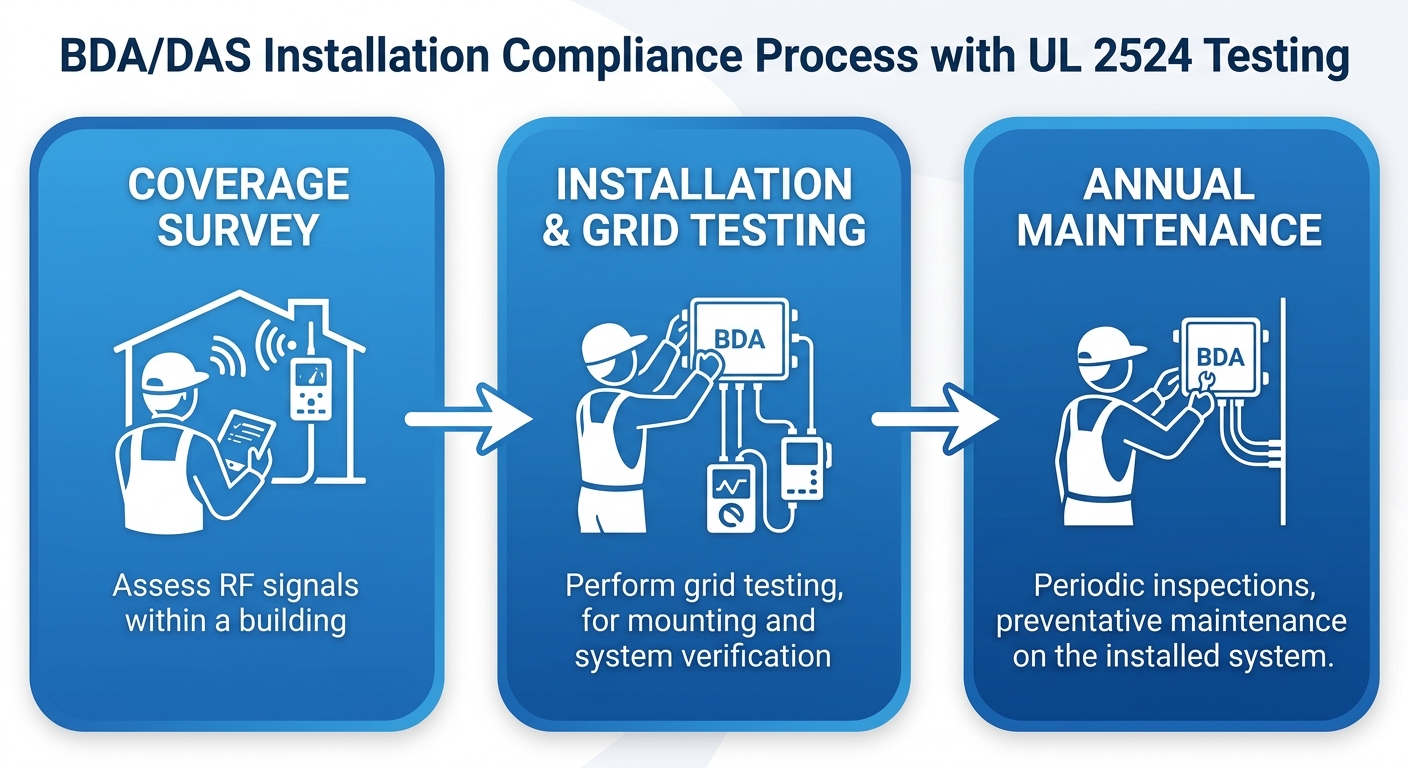
The three-stage journey begins with an emergency responder radio coverage survey and continues through installation and grid testing to annual maintenance.
Conducting an Emergency Responder Radio Coverage Survey
Before any equipment is installed, a comprehensive emergency responder radio coverage survey maps the building’s signal landscape. Our technicians use a calibrated spectrum analyzer to measure public safety radio frequency strength in every critical area–stairwells, basements, and parking garages. In accordance with Federal Communications Commission guidelines, signal levels must meet the -95 dBm threshold required by NFPA and IFC codes. This survey identifies dead zones and areas where coverage falls short, informing the exact placement of antennas and the configuration of the bi-directional amplifier. Buildings in Twin Falls, Boise, and across Southern Idaho often present unique obstacles–Low-E glass in modern offices and concrete cores in older structures–that the survey captures and quantifies. This foundational data ensures the final BDA/DAS design will deliver reliable in-building communication for first responders.
Each building type brings its own radio frequency challenges, and the appropriate solution varies accordingly.
| Building Type | Key Challenges | Recommended Solution |
|---|---|---|
| Office High-Rise | Low-E glass, concrete cores | DAS with multiple antennas |
| Hospital | Complex RF-shielded rooms | BDA with donor antenna on roof |
| School/K-12 | Limited budgets, multiple wings | Cost-effective BDA with zoning |
| Industrial Warehouse | Metal construction, large open spaces | High-power BDA with directional antennas |
These scenarios illustrate how we tailor solutions to each property’s unique construction.
BDA/DAS Installation and ERCES Grid Testing
Once the survey data is finalized, our team positions a donor antenna on the roof for optimal reception from the nearest public safety tower. Coaxial cabling and indoor antennas are routed per the design, meeting all fire-stopping and code requirements. The UL 2524-listed bi-directional amplifier is then integrated and powered up. The critical ERCES grid test follows: we measure signal strength at 20 equally spaced points per floor and verify that the -95 dBm threshold is achieved. A properly functioning bda das system is essential for mission-critical voice coverage, and the grid test confirms this performance. Our ERRCS BDA system services include end-to-end design, installation, and verification, ensuring AHJ acceptance. We also coordinate with the FCC for licensed frequency operation and provide a detailed test report for final sign-off.
Maintaining Compliance and Annual Testing
ERCES compliance demands annual re-verification. NFPA and IFC codes mandate a complete grid test every year to confirm the BDA/DAS system still meets the -95 dBm threshold. Our technicians perform the test, document the results, and submit them to the local AHJ. Any building renovation or system alteration also triggers re-verification. We monitor changes in FCC rules and UL standards to keep your system current. Should a test reveal a coverage gap, we promptly adjust antennas or upgrade components. We also maintain a digital compliance folder to simplify annual submissions and provide instant access during inspections. This proactive approach protects your investment and ensures reliable in-building communication throughout Southern Idaho.
Advanced Considerations for BDA/DAS System Integration and Maintenance
Beyond basic installation, advanced integration considerations for a bda das system can significantly impact performance and long-term cost. Selecting the right architecture helps balance coverage, scalability, and maintenance burdens for facilities across southern Idaho and the Northwest region.
The following table illustrates common approaches to integrating bi-directional amplifiers and distributed antenna systems with existing communications infrastructure:
| Approach | Description | Benefits |
|---|---|---|
| Standalone BDA | Single bi-directional amplifier with internal antennas | Low cost, quick deployment |
| Hybrid DAS | Combines BDAs with distributed antennas using RF over coax | Scalable coverage, fine-grained zoning |
| Fiber-Fed DAS | Uses fiber optic links to remote antenna units | Low loss over long distances, supports large venues |
| Networked/Cloud-Managed | IP-connected BDAs with remote monitoring | Real-time status, automated alerts, easier maintenance |
Standalone BDAs are best for small spaces with minimal zoning needs, where a single amplifier can cover a few rooms or a compact floor. The simplicity keeps deployment rapid and budget-friendly.
Hybrid DAS systems offer scalable coverage for mid-sized floors and help meet ERCES compliance requirements by distributing signal precisely where first responders need it most. This approach balances performance and cost while simplifying future expansions.
Fiber-fed DAS suits large venues like hospitals and stadiums, delivering low-loss signal across long distances. The ability to create independent zones is critical for meeting NFPA 72 and IFC ERCES mandates; fine-grained signal distribution helps ensure emergency responder radio coverage in every corner of a building.
Networked, cloud-managed BDAs add remote diagnostics, automated alerts, and performance logging that streamline maintenance scheduling and compliance reporting. Real-time monitoring supports faster issue resolution and simplifies documentation for public safety inspections.
Regardless of the integration approach, proactive maintenance–including annual grid testing per UL 2524 verification procedures–is essential for sustained compliance and coverage. UL 2524-listed components reduce fire-risk and simplify code inspections, while FCC rules (Part 90) require frequency coordination whenever bi-directional amplifiers operate on licensed frequencies. The Federal Communications Commission’s licensing framework ensures interference-free operation, and Underwriters Laboratories’ safety standard provides a foundation for code-compliant installations in Idaho and across the Northwest.
For reliable deployment and ongoing maintenance of these systems, partnering with a provider that understands the region’s unique compliance landscape is key. Our comprehensive telecommunications BDA services Idaho leverage nearly 50 years of Northwest experience to deliver cost-effective, code-compliant public safety radio coverage.
Frequently Asked Questions About BDA/DAS Systems
To summarize the key points, here are answers to frequently asked questions about BDA/DAS systems.
What is a BDA/DAS system?
A bda das system is an in-building coverage system that boosts two-way radio signals to ensure first responders maintain reliable communication throughout commercial buildings, meeting ERCES codes like IFC Section 510 and NFPA 72.
Why is ERCES compliance important?
Fire and building codes mandate reliable in-building radio coverage for emergency responders; we help you achieve ERCES compliance to protect your property from fines and occupancy delays while ensuring public safety radio coverage during critical incidents.
Who benefits from a BDA/DAS system?
Commercial building owners, property managers, and facility operators rely on our BDA/DAS systems to deliver emergency responder radio coverage in large or obstructed buildings, helping first responders maintain seamless, reliable, and instant communication during emergencies.
Ensuring Reliable Communication with BDA/DAS Solutions
A bda das system is essential for reliable in-building communication for first responders. The Federal Communications Commission (FCC) mandates public safety radio coverage in new and renovated buildings. Underwriters Laboratories (UL) 2524 listing ensures DAS/BDA equipment meets rigorous benchmarks to support emergency responder radio coverage and ERCES compliance. By amplifying public safety signals, these systems eliminate dead zones.
We offer building antenna signal booster services to enhance in-building reception. With nearly 50 years of experience, White Cloud Communications delivers BDA/DAS design, installation, and NFPA 72 / UL 2524 verification across the Northwest.