
Table of Contents
BDA System Specialists in Idaho: Essential for Public Safety Radio Compliance
BDA system specialists in Idaho are essential for ensuring public safety radio coverage meets stringent FCC and local fire code requirements, as only experienced specialists can navigate the complex regulatory landscape set by the Federal Communications Commission and Idaho’s adoption of IFC 2021.
Idaho’s building codes mandate ERCES code compliance with UL 2524 certified systems that achieve at least -95 dBm signal strength, as required by FCC regulations. General electricians or low-voltage contractors typically lack the radio frequency engineering expertise needed for proper BDA design, which can lead to fines or denial of occupancy permits. BDA system specialists conduct public safety radio coverage testing through grid testing methods–typically 20-point or more–to prove coverage meets NFPA 72 and IFC requirements. Their experience with local AHJ expectations streamlines approval, avoiding costly redesigns, and they provide ongoing maintenance like annual testing and battery checks to sustain compliance.
A properly designed and verified BDA DAS System ensures your building meets FCC and local fire code requirements. That’s why our team, with nearly 50 years of regional experience, performs ERCES grid testing and FCC-compliant installations, delivering seamless, reliable, and instant communication for public safety operations.
The Critical Role of BDA System Specialists in Idaho
In commercial buildings across Idaho, reliable in-building radio coverage for first responders is a life-safety mandate. Dense construction materials and LEED-certified glass often block critical signals, making it essential that firefighters, paramedics, and police can communicate on every floor. That’s why experienced bda system specialists in Idaho are indispensable for code-compliant installations.
The Role of BDA System Specialists in Idaho
BDA system specialists in Idaho design, install, and verify bi-directional amplifiers that boost public safety and cellular signals–VHF, UHF, and 700/800 MHz–inside buildings where coverage is weak. Our team at White Cloud Communications evaluates each building’s construction, antenna placement, and donor signal quality, then handles everything from initial signal surveys to FCC licensing and frequency coordination, preventing harmful interference. We perform on-site ERCES grid testing with calibrated tools, document coverage maps, and provide annual maintenance to keep systems compliant with Idaho’s fire code.
Specialists rely on two complementary architectures: Bi-Directional Amplifiers (BDAs) and Distributed Antenna Systems (DAS). The infographic below highlights the core differences.
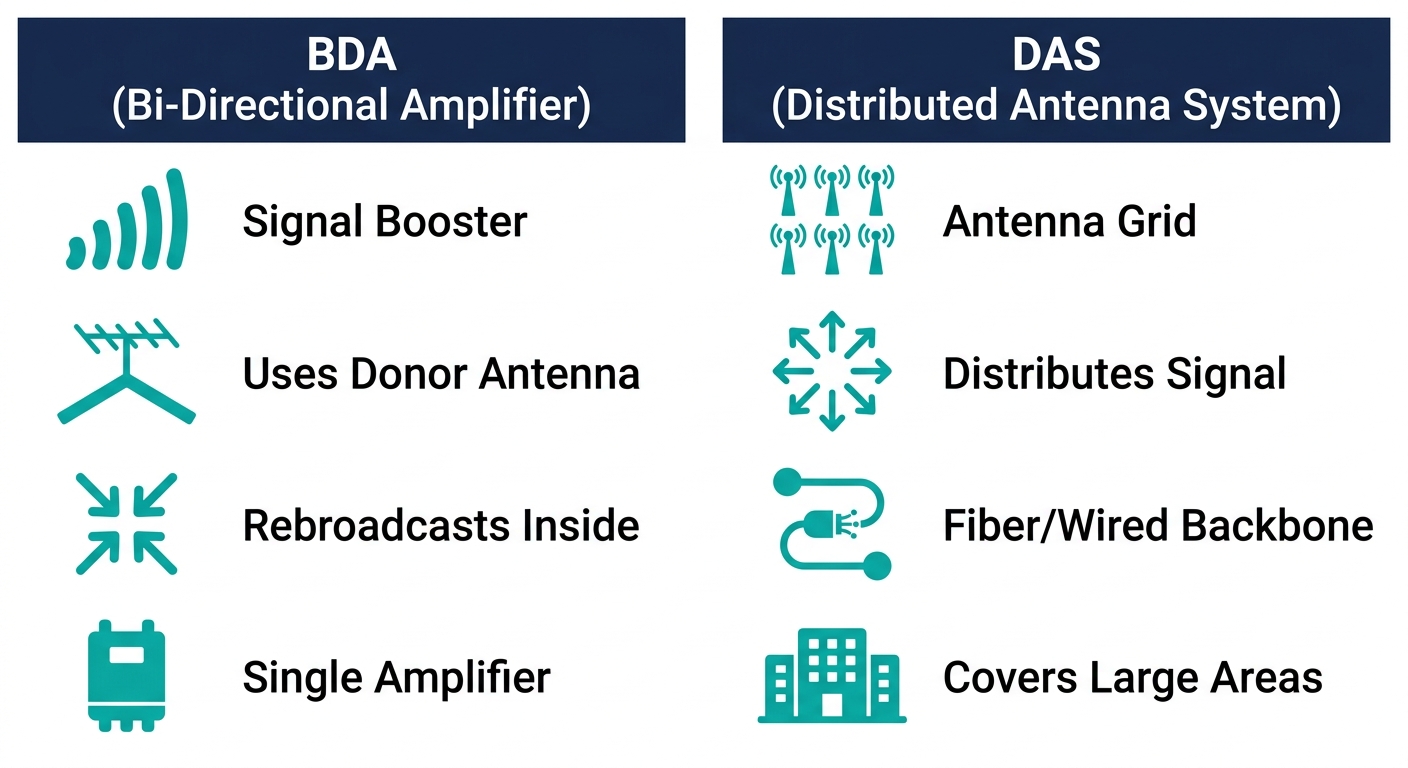
While both are essential for ERRC compliance, understanding each technology helps building owners choose the right solution for their facility.
Key Differences Between BDA and DAS Systems
A Bi-Directional Amplifier (BDA) and a Distributed Antenna System (DAS) serve distinct roles in an in-building network:
- BDA–A signal booster that captures outdoor signal, amplifies it, and redistributes it indoors through a few antennas; also repeats indoor signals back to the donor.
- DAS–An antenna grid that distributes amplified signal from a central source (often a BDA) via fiber or coax, providing uniform coverage across large or multi-story facilities.
When combined, a BDA feeds the DAS to deliver clear, continuous communication for first responders, even in underground parking garages.
When Does Your Building Need a BDA or ERCES Installation?
Idaho’s adoption of the International Fire Code (IFC 2021) mandates ERCES for buildings meeting specific criteria. A building typically requires a BDA or ERCES installation if it meets any of the following thresholds:
- High-rise buildings (three stories or more)
- Large commercial spaces over 50,000 sq ft
- Underground facilities (parking garages, subways)
- Hospitals, schools, and assembly areas
- Any building where first responder radio signal strength falls below -95 dBm (approx. one bar) on 99% of floor area.
Meeting ERCES code compliance means engaging a certified specialist to perform grid tests, document coverage maps, and ensure operation without interference under FCC Part 90. These criteria protect occupants and responders alike.
Why Certified Specialists Are Essential
Certified BDA system specialists bring expertise that general electricians or low-voltage installers cannot match. We manage every aspect of public safety radio coverage testing using calibrated signal analyzers to produce accurate coverage maps. By handling the FCC licensing and frequency coordination, we prevent illegal interference that could expose a building owner to significant fines. Engaging certified providers for professional bda system installation services ensures the system meets all FCC and NFPA requirements. All BDA systems must be licensed with the FCC and operate in compliance with NFPA 72 and UL 2524, ensuring ongoing reliability and monitoring. Once installed, regular testing and maintenance by these specialists ensures ongoing compliance and reliability.
Benefits of Partnering with BDA System Specialists in Idaho
Beyond understanding the technology, experienced bda system specialists in Idaho deliver the regulatory and operational expertise needed to meet fire codes, enhance signal coverage, and safeguard occupants.
Ensuring NFPA and IFC Fire Safety Compliance
The Federal Communications Commission (FCC) establishes the foundational rules for Emergency Responder Radio Coverage Systems (ERCES) that underpin NFPA 72 and IFC Chapter 5. As part of our Complete Communication Solutions, our specialists interpret these overlapping standards and design BDA systems that comply with UL 2524, eliminating guesswork. We coordinate early with architects to embed compliant ERCES solutions that satisfy all regulatory benchmarks and pass fire marshal inspections without delays or costly rework.
Meeting Idaho Fire Code Requirements for ERCES
Idaho fire code requires ERCES for new buildings over 25,000 square feet, renovations that alter signal penetration, and underground structures. Achieving ERCES code compliance means identifying these triggers early. Our team conducts thorough site assessments to determine your project’s obligations and engineers a compliant BDA system that meets state and local fire marshal expectations, helping keep construction on schedule and avoiding stop-work orders.
Improving Public Safety Radio Signal Strength
In-building BDA systems directly strengthen the radio signals that public safety personnel depend on during critical incidents. Reliable Two Way Radio communications between first responders and incident command is a lifeline when every second counts. Our specialists conduct comprehensive public safety radio coverage testing following NFPA 1221 methodology, validating that the system achieves a minimum -95 dBm signal strength and 99% coverage reliability in all required areas. Leveraging One of the Most Complete Communication Networks in the Northwest, we design BDA solutions that integrate seamlessly with existing public safety networks, so first responders maintain clear, uninterrupted communication even in stairwells, basements, and other RF-challenged spaces.
Reducing Liability and Enhanced Occupant Safety
Non-compliant BDA systems can lead to citations, fines, or closure orders from fire marshals, exposing building owners to significant legal and financial risk. By working with specialists in BDA systems, you mitigate these liabilities through code-aligned design, proper FCC licensing support, and proactive maintenance. We assist with FCC license applications and frequency coordination that many general contractors overlook, keeping your system legally operational. This comprehensive approach, backed by our commitment to Bringing You the Best, reduces your exposure and creates a safer environment for everyone inside, so that first responders have the connectivity they need when seconds count.
These benefits highlight the importance of expert-driven BDA system installation; next we explore the verification and ongoing maintenance that keep your system performing at its best.
How BDA System Specialists Ensure Code Compliance in Idaho
BDA system specialists at White Cloud Communications ensure code compliance in Idaho through rigorous public safety radio coverage testing and certification processes. With nearly 50 years of regional experience, we deliver complete communication solutions that meet FCC, NFPA 72, IFC, and UL 2524 standards.
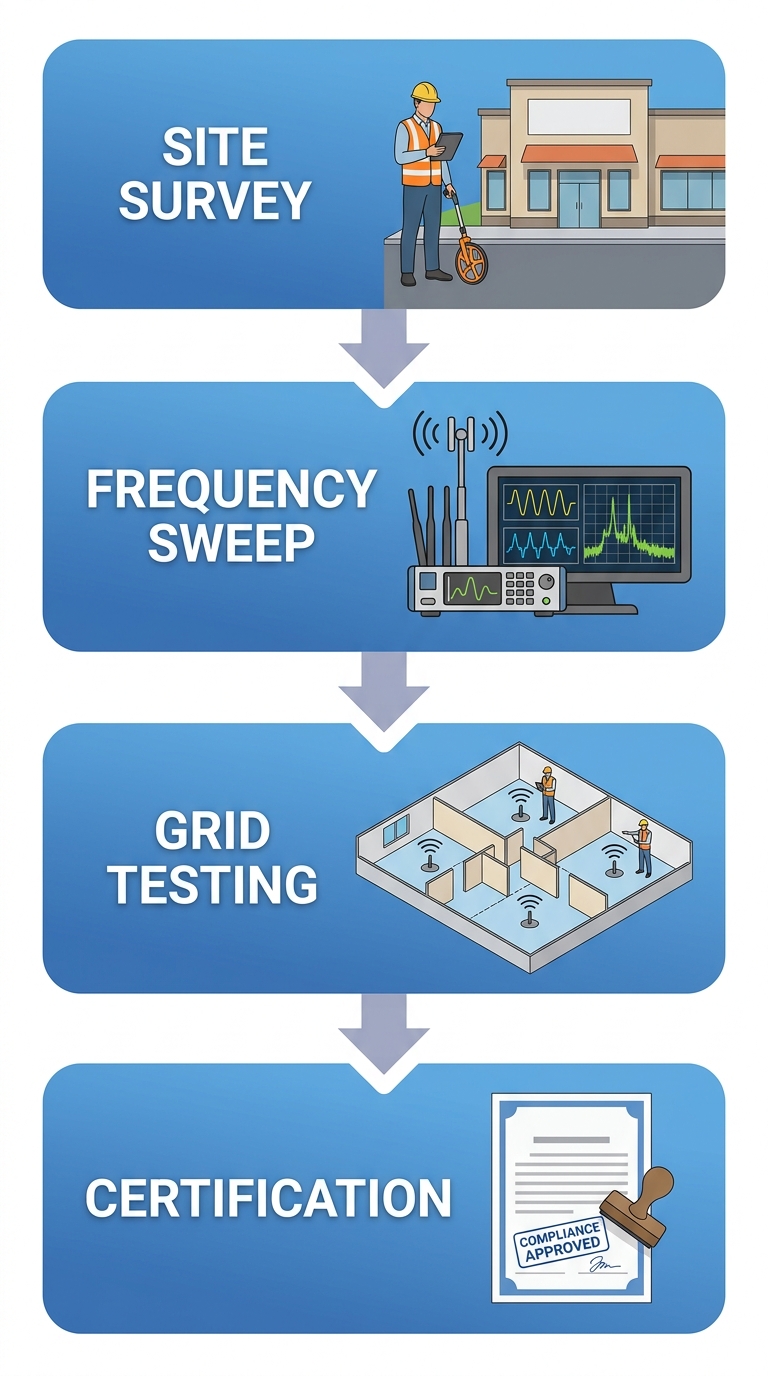
The BDA System Testing and Certification Process
BDA systems are a critical component of ERCES code compliance, ensuring first responders maintain clear radio signals inside buildings. Our testing process begins with frequency sweeps that measure signal strength across all applicable public safety radio bands, including VHF, UHF, and 700/800 MHz. According to FCC regulations, the minimum in-building signal strength must reach -95 dBm, and coverage must meet at least 99% of critical areas.
Our certification steps include:
- Comprehensive frequency sweeps and uplink/downlink performance measurement
- Verification that coverage exceeds 99% in defined zones
- Documentation of all test results for AHJ review
After these steps, we issue a certification report confirming the system satisfies FCC, NFPA 72, IFC, and UL 2524 standards.
Performing the 20-Grid Radio Coverage Test
The 20-grid radio coverage test is a cornerstone of NFPA 72 and International Fire Code (IFC) compliance. We divide the building’s floor plan into 20 equally sized grid zones and measure signal strength and audio quality in each. This granular approach ensures no dead spots compromise first responder communication. Test results must demonstrate that every grid location meets the minimum -95 dBm threshold with clear, intelligible audio. This test, required by local AHJs, is a non-negotiable part of ERCES verification. We compile the data into a comprehensive report that verifies the building meets all code requirements before final certification.
Annual Testing Requirements for Commercial Buildings
Commercial buildings in Idaho with BDA systems must undergo annual testing to maintain code compliance. NFPA 72 and local fire codes mandate that all active BDA equipment, backup power, and signal paths be inspected and performance-verified at least once per year. Our annual service includes a complete system check, frequency sweep, and 20-grid coverage test to ensure the system still meets the required -95 dBm threshold and 99% coverage. We document all test results and submit the required reports to the local Authority Having Jurisdiction (AHJ) for review. Any degradation in signal performance is immediately addressed through remediation or equipment adjustments. This proactive approach keeps buildings in continuous compliance and avoids costly violations.
Consequences of Failing a Public Safety Radio Signal Test
Failing a public safety radio coverage test triggers immediate consequences. The local AHJ issues a non-compliance notice, and the building owner must address the deficiencies within a specified period, typically 30 days. Failure to remediate can result in fines, occupancy restrictions, or a shutdown of the non-compliant area until the system passes retesting. Our BDA system specialists diagnose the root cause, whether it’s antenna misalignment, amplifier failure, or cable damage, and perform the necessary repairs. We provide a detailed report outlining the failure points and corrective actions, ensuring full AHJ documentation. After remediation, we retest the system to confirm it meets code. To avoid these consequences, regular bda system maintenance and monitoring is essential for long-term compliance.
Best Practices for Selecting BDA System Specialists in Idaho
Once you understand the importance of reliable in-building public safety coverage, selecting the right BDA system specialists in Idaho becomes critical. The specialist you choose directly influences long-term compliance and system performance. A methodical vetting process helps avoid costly compliance gaps.
Selecting a Qualified BDA System Specialist in Idaho
When evaluating BDA system specialists in Idaho, look for NICET certification in fire alarm systems or life safety. Industry-recognized credentials from the National Institute for Certification in Engineering Technologies signal a technician’s competency. Manufacturer-specific certifications–from SOLiD, Westell, or Nextivity–confirm hands-on expertise. Experience with Idaho’s diverse construction landscape is equally important. The specialist must understand how building materials and mountainous terrain affect RF propagation. Verify their portfolio of local installations. In our decades of service, we’ve seen that combined certifications and Idaho-specific knowledge yield the best outcomes.
Understanding Regional Authority Enforcement
ERCES code compliance in Idaho is enforced by the State Fire Marshal, local fire departments, and building departments, all of which adopt the IFC and NEC. Specialists must coordinate with the authority having jurisdiction (AHJ) to meet local requirements. The FCC mandates baseline public safety radio coverage rules, but local officials enforce verification before issuing an occupancy permit. A dedicated specialist stays informed of evolving standards, enabling smooth approvals and avoiding costly delays. We have cultivated strong AHJ relationships across southern Idaho that streamline compliance for building owners.
Annual Testing and Maintenance Schedules
Sustained compliance requires ongoing attention. IFC standards mandate annual retesting of BDA systems through the 20-grid test, measuring signal strength at defined points on each floor. Equipment degradation, antenna damage, or building changes can weaken coverage and lead to failed inspections. A proactive program with continuous monitoring, annual testing, and prompt repair protects your investment. Your specialist should offer maintenance plans that combine inspection, documentation, and on-demand service. At White Cloud Communications, our agreements keep your system compliant year-round with documented test results. Our monitoring services alert you to potential issues before they cause a failed test.
Getting Certified Public Safety Radio Coverage Testing
Finding a provider that offers certified public safety radio coverage testing is essential. The 20-grid test must be conducted by knowledgeable technicians who can interpret results and submit reports to the local AHJ. Look for rapid response capabilities for initial commissioning and annual recertification. Testing must be thorough and aligned with fire marshal requirements. Our team at White Cloud Communications delivers fast, certified grid testing with accurate data. A full-service provider that handles both installation and testing simplifies your compliance process and eliminates vendor coordination challenges. Our rapid response teams are positioned across southern Idaho to serve you promptly.
Ready to secure your building’s public safety communications? For a free assessment and expert guidance, reach out to White Cloud telecommunications contact. We look forward to assisting you.
Next Steps for BDA System Compliance in Idaho
With these regulatory requirements in mind, here are the concrete next steps to ensure your BDA system is fully compliant in Idaho. Partnering with experienced BDA system specialists in Idaho is the first critical step toward compliance.
- Engage a qualified BDA system specialist. We recommend starting with an on-site survey and radio coverage assessment to identify dead zones and compliance gaps.
- Design for Idaho code and ERCES code compliance. The system must meet Idaho’s fire code (IFC 2018/2021) and NFPA 72/UL 2524 standards. If operating on public safety frequencies, we assist with FCC license applications.
- Submit FCC licensing and frequency coordination. Our team helps file accurate applications through the FCC’s Universal Licensing System to prevent processing delays.
- Install and test the BDA/DAS system. Using certified equipment, we install the system and perform ERCES grid testing–public safety radio coverage testing–to confirm coverage meets the required -95 dBm minimum signal strength.
- Document and present to the AHJ. We compile all test results, equipment certifications, and regulatory filings for submission to the local authority having jurisdiction, typically the fire marshal.
- Schedule regular verification. Maintain ongoing compliance with annual verification testing and system logs to ensure continuous public safety radio coverage.
Once compliance is achieved, ongoing maintenance and monitoring are essential to remain in compliance. For expert assistance at every stage, contact White Cloud Telecommunications Support Contact.
All BDA systems must comply with FCC licensing and narrowband requirements; noncompliance can result in fines. Always verify compliance with local IFC/NFPA 72/UL 2524 standards. As a regional leader with nearly 50 years of experience, we deliver Complete Communication Solutions tailored to Idaho’s unique regulatory landscape.