
Table of Contents
The Foundation of Critical Communication: Two-Way Radio Systems
A two way radio system enables instant, simultaneous voice communication between multiple users, forming the backbone of critical operations in fields like public safety, construction, and hospitality. These reliable networks underpin daily coordination where every second counts.
At the core of any robust communication network lies the two-way radio–a proven technology that has evolved from analog to digital to meet modern demands. Today, digital standards like DMR (Digital Mobile Radio) and P25 deliver seamless, reliable, and instant communication with enhanced audio clarity, coverage, and security. Whether agencies rely on legacy analog or upgraded digital, our systems support both, ensuring continuity and performance. For in-building resiliency, we also integrate technologies like the Bi-Directional Amplifier and ERCES testing to extend coverage in challenging environments.
All two-way radio systems operating on licensed frequencies must comply with Federal Communications Commission regulations; users should obtain and maintain required licenses, as noncompliance can result in fines. The Telecommunications Industry Association sets standards like TIA-603 to ensure interoperability across different manufacturers–a critical requirement for multi-agency responses. Instead of blanket guarantees, we design systems to maximize reliability within your specific environment.
For organizations seeking a trusted partner with nearly 50 years of regional experience across Southern Idaho and the Northwest, we offer comprehensive White Cloud two-way radio services tailored to your operations. Building on this foundation, we also deploy complementary technologies like DAS and in-building amplifiers to ensure complete coverage.
Two-Way Radio Essentials: VHF and UHF Selection, FCC Licensing, and the Core Technology
Understanding two-way radio essentials–VHF and UHF frequency selection, FCC licensing, and core digital standards–helps businesses make informed decisions. The Federal Communications Commission requires licensing for most commercial radios, and the technology choices between VHF’s long-range outdoor performance and UHF’s building penetration define system design. Our team at White Cloud Com guides organizations through these choices to build reliable, compliant networks.
The table below summarizes the key differences between VHF and UHF two-way radios, from frequency range to typical applications.
| Feature | VHF Two-Way Radios | UHF Two-Way Radios |
|---|---|---|
| Frequency Range | 136-174 MHz | 400-512 MHz |
| Propagation Characteristics | Longer wavelengths, travel farther in open areas with fewer obstructions | Shorter wavelengths, better at penetrating building materials |
| Penetration Through Obstacles | Limited ability to penetrate dense materials like concrete and steel | Excellent penetration through walls, floors, and urban structures |
| Best For Outdoor/Indoor Use | Ideal for outdoor, rural, and open-area communications | Well-suited for indoor environments, industrial facilities, and urban settings |
| Typical Applications | Farming, forestry, maritime, search and rescue, long-range outdoor operations | Manufacturing, healthcare, hospitality, education, public safety in buildings |
| Licensing Requirements | FCC license required for most commercial use | FCC license required for most commercial use |
For open-air environments such as agricultural operations in Southern Idaho, VHF’s longer wavelengths provide extended range. Conversely, indoor facilities–hospitals, manufacturing floors, and schools–benefit from UHF’s ability to penetrate walls and steel. Businesses looking to deploy robust communication can explore our two-way radio for industries page, which details solutions for manufacturing, healthcare, hospitality, and more.
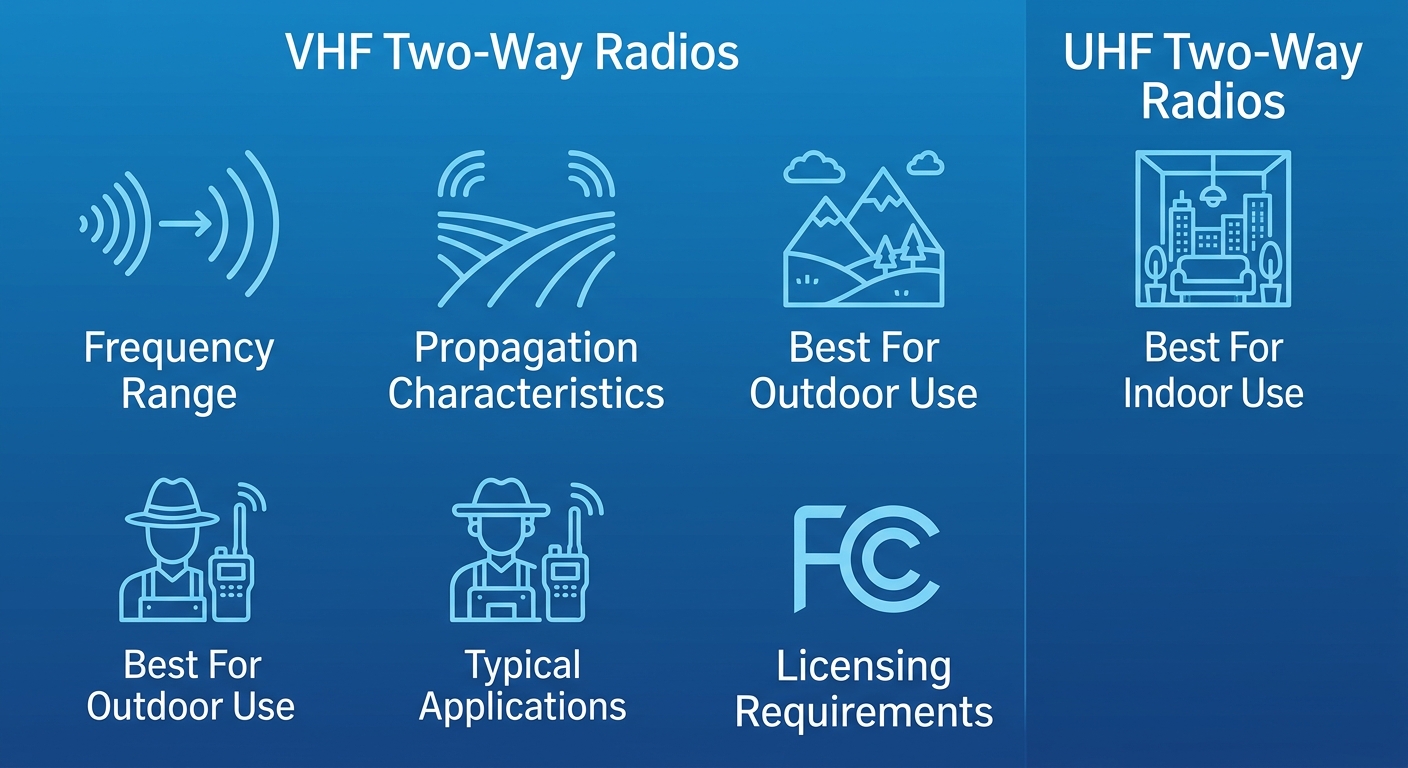
FCC licensing is required for most commercial use; noncompliance can result in fines. According to the Federal Communications Commission, most businesses operating two-way radios must hold a valid license. We help clients across Southern Idaho with every step of FCC licensing–from frequency coordination and initial application preparation to renewals and modifications–so compliance is never a burden.
Modern two-way radio systems leverage digital standards to optimize performance. The Telecommunications Industry Association’s Project 25 (P25) standard ensures interoperability for public safety agencies, while Digital Mobile Radio (DMR) provides efficient, spectrum-friendly communication for commercial users. Land Mobile Radio (LMR) remains the foundation for mission-critical voice. Repeaters extend coverage, and Bi-Directional Amplifiers (BDAs) boost in-building signals where required. ERCES testing, mandated by NFPA/IFC codes, verifies that these amplifiers meet strict safety standards. Our certified engineers design and validate systems that meet local code requirements.
With the radio fundamentals established, we can now examine how Distributed Antenna Systems and Bi-Directional Amplifiers extend coverage indoors.
Expanding Your Coverage: Repeater Systems, BDA Technology, and In-Building Radio Solutions
Beyond basic mobile and portable radios, expanding coverage across large or obstructed areas calls for specialized equipment.
Understanding Radio Repeaters and Their Role in Expanding Coverage
A radio repeater receives a weak signal on one frequency and retransmits it at higher power on another, extending the range of two way radio communications. Without repeaters, a portable two way radio might only cover a few miles, but a properly placed repeater network can serve an entire county or municipal area in Idaho.
Modern repeaters support analog and digital protocols including P25, DMR, and LMR, ensuring compatibility with legacy equipment and advanced features. White Cloud Com designs and installs repeater solutions that integrate seamlessly, whether you operate a small construction crew using basic analog radios or a public safety agency requiring encrypted digital transmission. We evaluate terrain, frequency licensing, and user density to position repeaters for consistent audio across your operational footprint. With nearly 50 years of regional experience and a network of over 70 towers, we often place repeaters at optimal locations to minimize dead zones and maximize coverage, bringing you the best possible signal penetration for your two-way radio users.
Bi-Directional Amplifier (BDA) Systems for In-Building Coverage
While outdoor repeaters handle wide-area coverage, a Bi-Directional Amplifier–or BDA–overcomes signal loss inside structures where concrete, metal, and low-E glass block radio waves. A BDA amplifies both the uplink and downlink signal paths, ensuring consistent in-building coverage even in challenging environments.
At White Cloud Com, we provide end-to-end BDA DAS System solutions that integrate BDAs with Distributed Antenna Systems for uniform signal strength. This integration is critical for public safety communication: firefighters, EMS, and law enforcement depend on two-way radios inside buildings, and a dead zone can compromise safety. Our engineered systems are tested to meet NFPA 72 and UL 2524 standards, and our Complete Communication Solutions portfolio includes comprehensive site surveys, grid testing, and performance verification. We also handle FCC licensing and frequency coordination, delivering end-to-end compliance from spectrum to infrastructure. With nearly fifty years of experience serving Idaho, we install reliable, code-compliant BDA/DAS systems that give building owners and first responders the confidence that their communication systems will perform when needed.
Choosing between active and passive Distributed Antenna Systems (DAS) depends on facility size, complexity, and compliance needs. The following table highlights key differences.
| Feature | Active DAS | Passive DAS |
|---|---|---|
| Signal Distribution Method | Uses fiber optic or coaxial cable to distribute signals from a central headend | Relies on passive splitters, couplers, and antennas without powered components in the signal path |
| Coverage Area | Large buildings, campuses, and complex multi-story structures | Smaller buildings, warehouses, and simple floor plans |
| Complexity | Higher complexity, requiring professional design and integration | Lower complexity, easier to deploy but less flexible for large venues |
| Scalability | Highly scalable; can cover millions of square feet with precise coverage control | Limited scalability; signal loss increases with distance and number of splits |
| Cost | Higher initial cost but often more cost-effective for large deployments | Lower initial cost for small sites, but may require more equipment for full coverage |
For buildings requiring public safety radio coverage, Active DAS solutions often provide the reliability and coverage uniformity demanded by fire codes and first responders. Passive DAS can be a viable option for smaller businesses, but proper RF planning is essential to avoid dead zones.
Because BDAs frequently serve emergency responders, Idaho building codes mandate in-building radio coverage for public safety.
Regulatory Requirements for In-Building Emergency Radio Coverage in Idaho
Idaho has adopted the International Building Code (IBC) along with NFPA standards that mandate minimum in-building radio coverage for emergency responders. Buildings that fail to meet the 90% signal coverage threshold in critical areas — or those exceeding 25,000 square feet or multiple floors — must install an emergency radio communication system, typically a BDA/DAS solution. These requirements ensure that firefighters, police, and EMS personnel can communicate reliably during incidents.
White Cloud Com provides ERCES testing and verification to confirm that your building complies with NFPA 72, UL 2524, and local amendments. Our certified technicians conduct on-site signal surveys, design engineered solutions, and perform final grid testing to document coverage. We also provide documentation for the authority having jurisdiction (AHJ) and assist with ongoing maintenance and re-certification as codes evolve. These services are critical for obtaining occupancy permits and maintaining compliance with state fire codes. With nearly five decades of experience in Idaho’s regulatory environment, we help building owners achieve peace of mind while meeting life-safety obligations.
Deploying Two-Way Radios in Your Operation: Cellular Comparisons, Talkgroup Planning, and BDA Cost Factors
When you’re ready to deploy two way radio in your operation, three critical decisions must be addressed: comparing radios to cellular phones, planning channel and talkgroup configurations, and understanding the cost and compliance of Bi-Directional Amplifier (BDA) installations.
Two-Way Radios vs. Cellular Phones: A Comparative Look
As the comparison below highlights, two-way radios deliver crucial advantages for operational teams.
| Feature | Two-Way Radios | Cellular Phones |
|---|---|---|
| Communication Type | Instant group push-to-talk (one-to-many) | One-to-one calls; group communication requires third-party apps |
| Reliability During Emergencies | Operates on dedicated frequencies; less congested during disasters | Network congestion and tower damage can cause service outages |
| Push-to-Talk Capability | Instant, no dialing; designed for rapid coordination | Requires dialing and may not support instant group talk without an app |
| Coverage in Remote Areas | Can be extended via repeaters; works where cell coverage is absent | Limited to carrier tower locations; dead zones in rural/industrial sites |
| Cost Over Time | Higher upfront equipment cost, then low or no recurring fees | Lower device cost but ongoing monthly service fees per user |
| Durability | Built to military/industrial standards (MIL-STD); drop-resistant, weatherproof | Consumer-grade fragility; often requires protective cases |
When an emergency strikes, the dedicated frequencies of two-way radios keep communications clear, whereas cellular networks often become congested. The instant push-to-talk capability allows team members to coordinate in fractions of a second without dialing, which is essential for public safety and industrial environments. Over time, the cost structure favors radios with no per-user monthly fees after the initial equipment investment. Finally, radios are purpose-built for harsh conditions, meeting MIL-STD standards for shock, vibration, and weather, while typical smartphones lack that ruggedness.
Channel Planning and Talkgroup Configuration for Your Team
When your team spans multiple departments or geographic sites, effective radio communication requires a thoughtful allocation of channels and talkgroups. Drawing on industry standards from the Telecommunications Industry Association, we recommend first mapping who needs to talk to whom and under what circumstances. A well-designed channel plan segments broad groups–such as a campus-wide channel–from department-specific talkgroups that keep conversations focused.
Implementing a structured two way radio channel plan can transform daily coordination. For a school district with 10 schools, assign a campus-wide channel for maintenance and separate talkgroups for each department (facilities, security, admin). This approach delivers seamless, reliable, and instant communication across the district while preventing cross-talk that can slow response times.
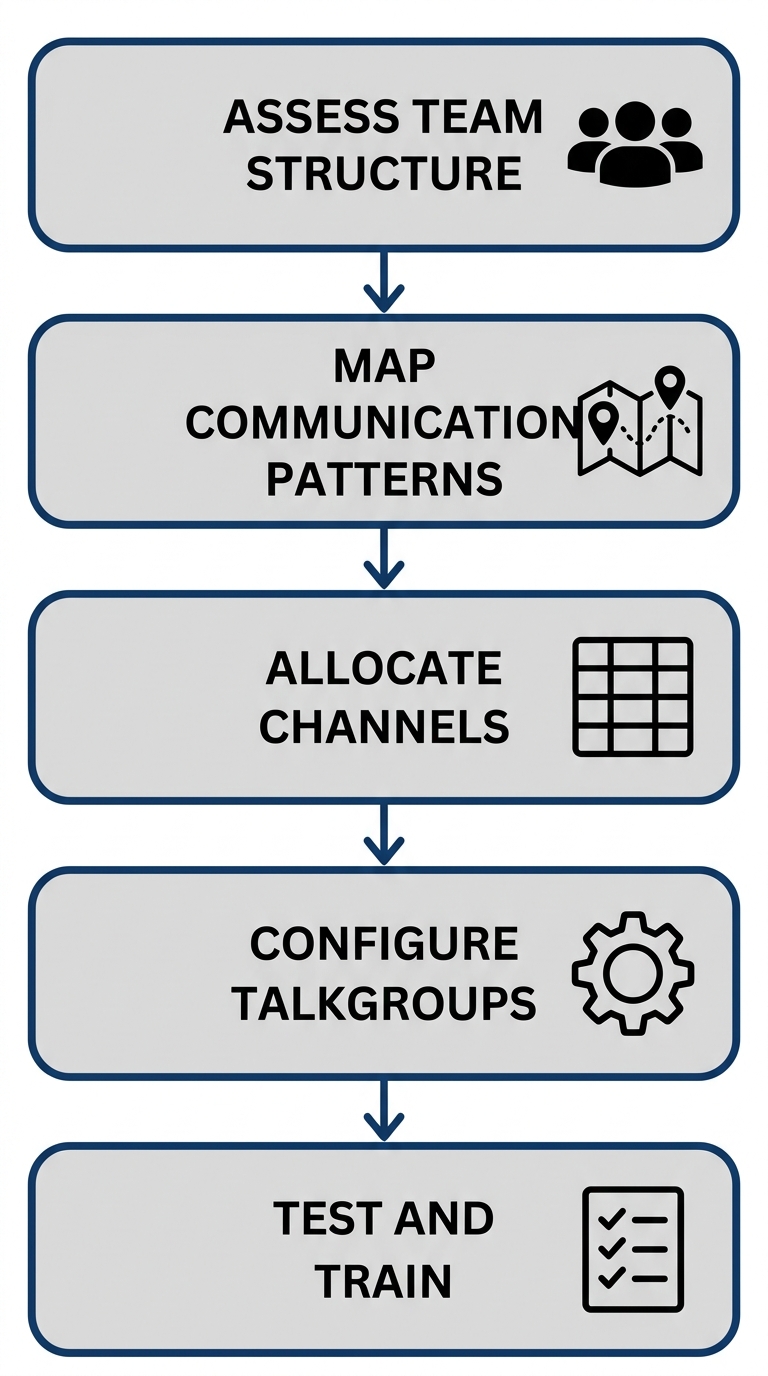
The same logic applies to public safety agencies: a fire battalion may use a primary tactical channel while each crew operates a squad-level talkgroup. Proper planning ensures that critical messages reach the right ears instantly.
Cost Factors and FCC Compliance for BDA Installations
Deploying an in-building Bi-Directional Amplifier (BDA) system involves three primary cost drivers: equipment type (single-band vs. multi-band), installation complexity (structural modifications and cable runs), and mandatory ERCES testing to verify emergency responder coverage. As a fundamental regulatory requirement, the Federal Communications Commission mandates that BDA systems be FCC-certified under Part 90 and that operators file Form 601 or 605 for a Part 90 license, maintaining narrowband efficiency at 12.5 kHz. Users must obtain and maintain FCC licenses; noncompliance can result in fines. Additionally, every BDA deployment must meet NFPA 72, IFC, and UL 2524 requirements to be code-compliant. For a tailored installation, contact our BDA System Specialists for a site assessment and compliance planning.
Advanced Considerations: FCC Licensing, Frequency Coordination, and ERCES Compliance Testing
Moving into advanced considerations, two-way radio systems require careful attention to FCC licensing and frequency coordination before they can be lawfully deployed. The Federal Communications Commission (FCC) mandates licenses for all base stations, mobile units, and Bi-Directional Amplifier (BDA) or Distributed Antenna System (DAS) equipment that operates on licensed public safety or business frequencies. Before applying for a license, organizations must complete frequency coordination–submitting proposed frequencies to a certified Frequency Coordinator such as the Telecommunications Industry Association (TIA) to prevent harmful interference. This step validates two-way radio frequency assignments, ensuring they won’t conflict with existing services. It is critical that system owners obtain and maintain all required FCC licenses; noncompliance can result in significant fines.
Beyond licensing, facilities in Southern Idaho must meet evolving ERCES compliance standards. Bi-Directional Amplifier (BDA) and DAS installations supporting emergency responder radio coverage are tested under NFPA 72 or the more stringent NFPA 1225. Annual ERCES testing performed by certified technicians with calibrated equipment, with documentation maintained for AHJ review, is mandatory. Non-compliance risks failed inspections and costly retrofits. The following table illustrates the shift in requirements between the two standards.
| Requirement | NFPA 72 (2019) | NFPA 1225 (2023) |
|---|---|---|
| Coverage Threshold | -95 dBm minimum signal strength in 99% of general building areas | -95 dBm in 99% of general areas and -93 dBm in 99% of critical areas (stairwells, fire command centers) |
| Testing Frequency | Annual testing required | Annual testing, with more frequent monitoring for systems that have experienced changes or failures |
| Acceptable Signal Strength | -95 dBm for public safety bands | Stricter thresholds as above, with additional requirements for noise and uplink performance |
| Certification Requirements | Must be verified by a qualified person | Testing must be performed by certified technicians using calibrated equipment; documentation must be maintained |
Meeting NFPA 1225’s stricter benchmarks is critical to avoid failed inspections and costly retrofits.
White Cloud Communications’ end-to-end expertise bridges FCC licensing, frequency coordination, and ERCES testing for complete compliance. We assist with applications, grid testing, and help facilities meet NFPA 1225 requirements, backed by nearly 50 years of regional service. Contact us to see how our custom two-way radio solutions simplify these advanced considerations.
Frequently Asked Questions About Two-Way Radio and BDA Systems
Here are answers to common questions about two-way radio and BDA systems in Southern Idaho.
Do I need an FCC license for a two way radio? Yes, the Federal Communications Commission requires licenses for most commercial and public-safety frequencies. We assist with applications, renewals, and frequency coordination to keep your operations compliant and avoid fines.
What is a Bi-Directional Amplifier? A BDA boosts cellular and public-safety radio signals inside buildings. It must comply with ERCES standards including NFP 72 and U 2524, and we design and install systems that meet all applicable code requirements.
Why is ERCES testing important? ERCES testing verifies that in-building coverage meets first responder communication requirements. Our comprehensive grid testing and certification ensures your system passes inspection and maintains reliable signal penetration throughout the facility.
Your Reliable Communication Partner: White Cloud Communications Inc.
As a regional leader in two-way radio communications, White Cloud radio communication solutions have formed the backbone of seamless, reliable, and instant connectivity for organizations across the Northwest for decades. With nearly 50 years of experience, we design, deploy, and maintain two-way radio and in-building DAS/BDA systems that keep teams connected when it matters most.
Our owned and networked tower infrastructure — more than 70 tower sites — provides a resilient wide-area backbone that supports critical voice and data traffic for public safety, industrial, and commercial users. We focus exclusively on serving businesses in Southern Idaho and throughout the Northwest, offering Complete Communication Solutions that span system design, FCC licensing, installation, and 24/7 support. The result is One of the Most Complete Communication Networks in the Northwest — purpose-built to deliver clear, dependable communication without compromise.