
Table of Contents
Understanding Fire Code Radio Signal Testing Essentials
In emergencies, first responders rely on clear radio communications inside buildings, but weak signals can turn lifelines into liabilities. Fire code radio signal testing in Idaho addresses this by verifying indoor signal strength to ensure reliable connectivity for public safety. This process is vital for commercial and industrial facilities in southern Idaho, where poor coverage could delay critical responses and endanger lives.
Idaho adopts the International Fire Code (IFC) Section 510 and NFPA 72 standards, mandating in-building public safety radio coverage for structures over 50,000 square feet or high-rise buildings. These regulations evolved from post-9/11 awareness of communication failures in high-risk scenarios, with local enforcement varying by jurisdiction–stricter in urban areas like Twin Falls and Idaho Falls. Common systems include Emergency Responder Radio Coverage Systems (ERRCS), Bi-Directional Amplifiers (BDA), and Distributed Antenna Systems (DAS), all requiring regular testing to achieve at least 95% signal strength and avoid fines up to $10,000 per violation. Compliance failures, as seen in recent audits, often stem from untested installations, underscoring the urgency of emergency radio signal verification.
White Cloud Communications, headquartered in Twin Falls, brings over 50 years of expertise in designing and maintaining BDA system compliance NFPA 72 across southern Idaho’s diverse sectors. Their certified technicians provide FCC licensing integration and 24/7 support, leveraging a network of 70+ towers to eliminate dead zones in hospitals, campuses, and manufacturing sites. Property managers in Idaho Falls and beyond trust White Cloud for tailored solutions that meet local fire codes without disruption.
This guide explores the fundamentals of indoor fire code testing, step-by-step procedures, and ongoing maintenance strategies. What foundational elements drive these requirements? Discover how proactive testing enhances responder safety and simplifies compliance for your facility.
Core Principles of ERRCS and BDA Compliance
Fire Code Radio Signal Testing in Idaho forms the backbone of ensuring reliable emergency communications in buildings. These systems address critical gaps in radio signals, guaranteeing that first responders can communicate effectively during crises. Understanding the core principles of Emergency Responder Radio Coverage Systems (ERRCS), Bi-Directional Amplifiers (BDA), and Distributed Antenna Systems (DAS) is essential for compliance basics for ERRCS and overall safety protocols.
ERRCS represents a vital infrastructure for radio signal fundamentals, required in Idaho buildings exceeding 50,000 square feet. This system enhances two-way coverage for emergency responders, focusing on in-building public safety radio coverage to eliminate dead zones. By distributing signals evenly, ERRCS ensures public safety radio communications remain strong, meeting mandates under the International Fire Code (IFC) Section 510. For instance, in larger facilities like hospitals, ERRCS prevents signal loss in basements or shielded areas, directly supporting life-saving operations.
DAS complements ERRCS by deploying a network of antennas to propagate signals throughout the structure. These systems work in tandem to achieve uniform coverage, adapting to building materials that might otherwise block transmissions. Together, they form the foundation for robust emergency response capabilities.
A bda system boosts weak external signals for bi-directional use, crucial when donor sites are distant. It amplifies incoming and outgoing transmissions, ensuring clarity for firefighters and police. In BDA system compliance NFPA 72, standards dictate monitoring and alarm features to maintain performance. This setup is particularly useful in mid-sized buildings where full ERRCS might be excessive, providing cost-effective signal enhancement.
When selecting between ERRCS and BDA, consider building size and signal needs; ERRCS excels in expansive structures over 50,000 square feet, while BDA suits amplification in smaller or signal-challenged sites, per IFC 510 guidelines for Idaho properties.
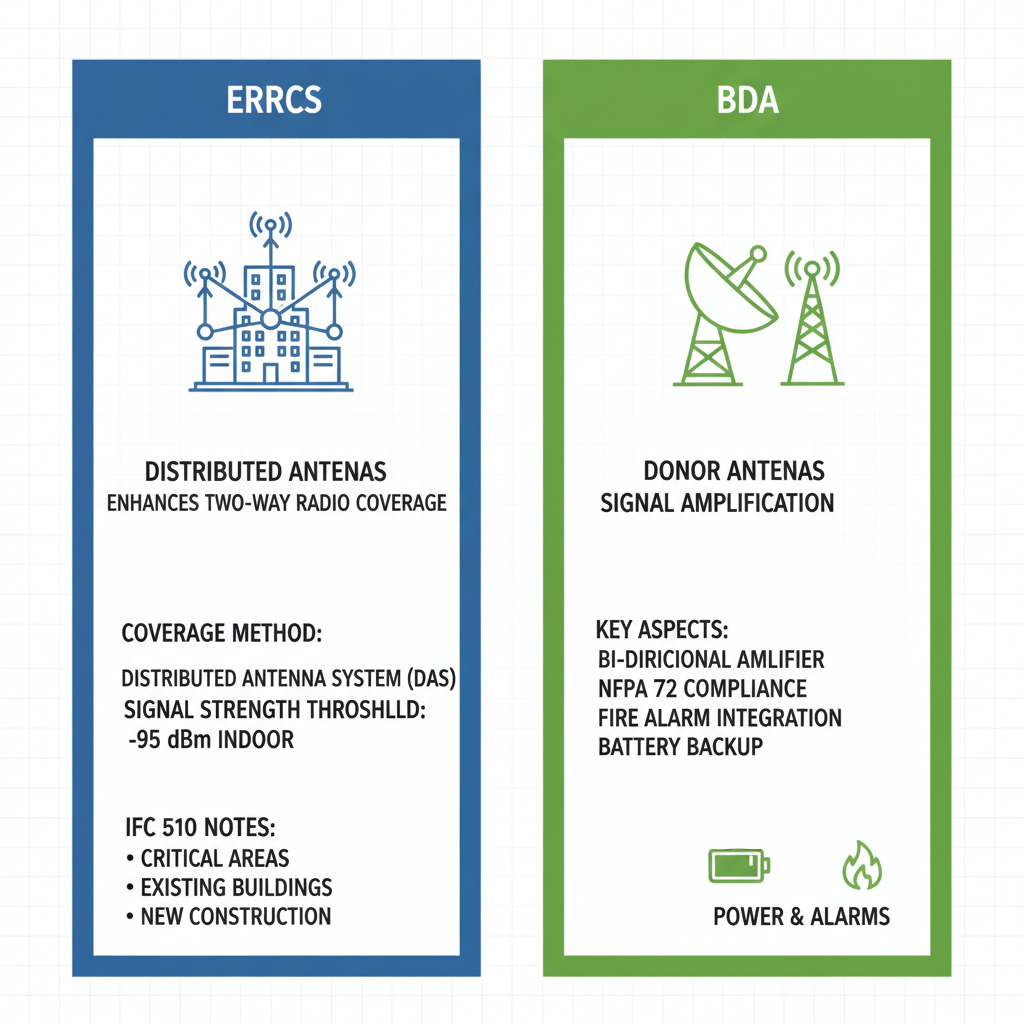
Visual comparison of ERRCS and BDA systems for public safety compliance
The following table outlines fundamental differences to aid initial compliance understanding:
| Aspect | ERRCS | BDA |
|---|---|---|
| Purpose | Enhances two-way radio coverage for emergency responders in large buildings. | Amplifies weak incoming signals for bi-directional communication. |
| Coverage Method | Distributed antennas for broad signal distribution. | Single or multi-band amplification with donor antennas. |
ERRCS proves ideal for larger Idaho structures like the Twin Falls hospital, offering comprehensive coverage based on IFC 510 standards, whereas BDA targets precise amplification needs, with NFPA 72 outlining testing frequencies for reliability.
Compliance basics revolve around achieving minimum signal strengths under IFC 510 and NFPA 72. These codes mandate pre-occupancy testing to secure fire permits, ensuring systems operate before building use. Key thresholds include:
- Downlink signal at -95 dBm for usable reception.
- Uplink at -100 dBm to transmit back to dispatch.
Installation requires certified professionals to integrate monitoring panels that alert for failures. IFC 510 emphasizes donor site evaluations for BDAs, verifying external signal quality to avoid interference.
In Idaho, enforcement aligns with national codes but includes local adaptations, such as stricter reviews for high-rise or healthcare facilities. The state’s building officials prioritize IFC 510 for new constructions, integrating NFPA 72 for BDA monitoring to enhance responder safety. For example, Twin Falls regulations often reference these for hospital expansions, ensuring seamless in-building coverage.
Initial testing introduces tools like spectrum analyzers to measure dBm levels, a simple signal usability measure indicating strength. Technicians scan frequencies during walkthroughs, documenting coverage maps. Donor site considerations for BDAs involve assessing proximity to towers, with backups required if signals falter. This foundational testing, timed pre-occupancy, confirms compliance and paves the way for ongoing maintenance under NFPA 72.
Now that basics are clear, explore detailed testing protocols in the next section.
In-Depth ERRCS Testing Protocols and Procedures
Fire Code Radio Signal Testing in Idaho demands rigorous protocols to guarantee reliable in-building public safety radio coverage, especially in multi-tenant buildings across cities like Idaho Falls. These detailed ERRCS protocols ensure systems meet 99% coverage requirements under the International Fire Code (IFC) 510, focusing on emergency responder communications during critical incidents. By following these signal testing depths, building owners and technicians can avoid compliance failures and protect first responders.
Signal Strength Measurement Techniques
Advanced signal strength measurement begins with verifying donor signals outside the building to establish baseline performance. Technicians then conduct downlink and uplink testing using calibrated equipment, scanning 700/800 MHz frequency bands essential for public safety radios. For multi-floor structures, a grid testing pattern divides the space into zones, typically 20×20 feet, to map coverage comprehensively.
- Calibrate test equipment per manufacturer standards, ensuring accuracy within 1 dB.
- Position the signal generator to simulate first responder transmissions.
- Measure received signal strength in dBm at multiple points, targeting -95 dBm minimum for voice clarity.
This approach, often called first responder radio coverage analysis, confirms uniform distribution. Uplink testing reverses the process, evaluating signal return from handheld radios to the base station.
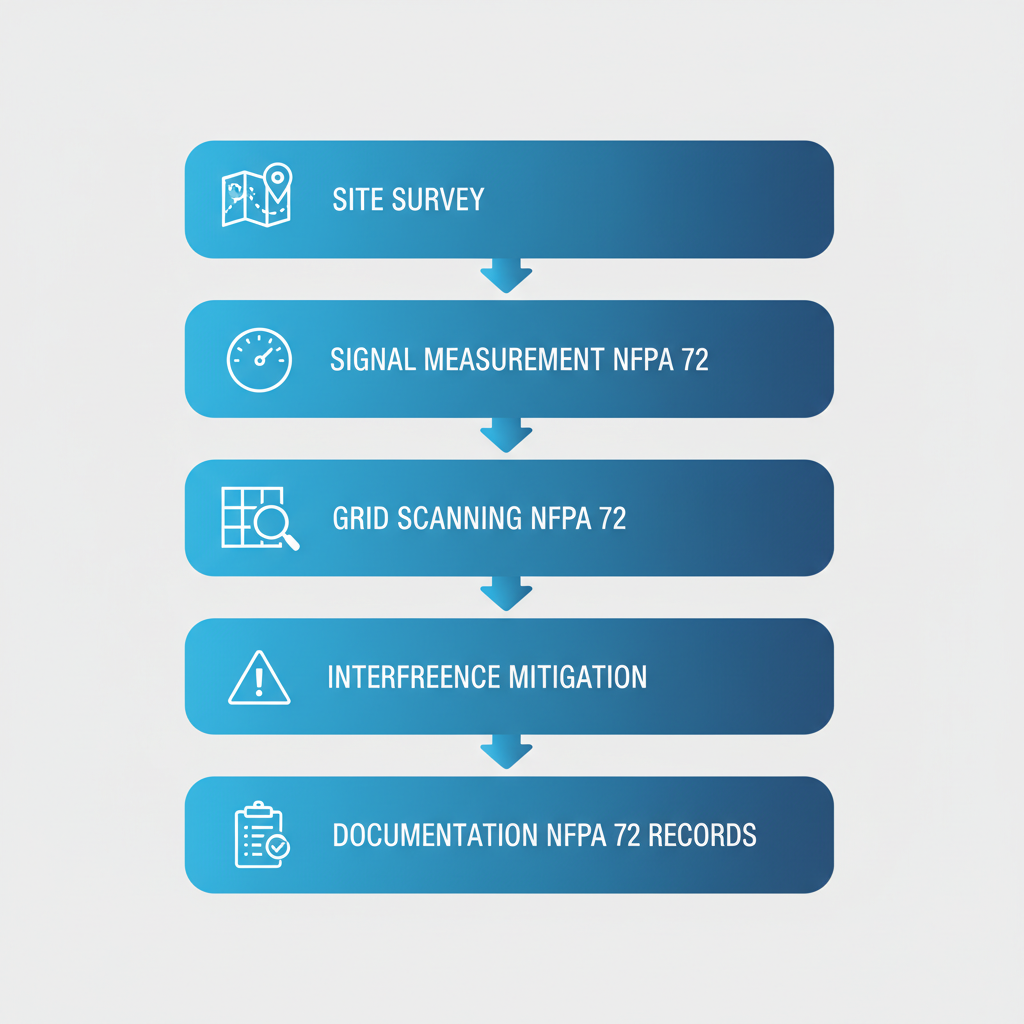
Step-by-step ERRCS testing procedure ensuring NFPA 72 compliance in Idaho facilities
Selecting the right method is crucial for thorough evaluation. The following table compares active and passive testing approaches for ERRCS, highlighting equipment and accuracy differences.
| Method | Active Testing | Passive Testing |
|---|---|---|
| Equipment Needed | Spectrum analyzer, signal generator | Basic radio scanners |
| Accuracy | High, simulates real transmissions | Lower, measures ambient signals |
Active testing aligns with IFC 510 requirements for certification, providing precise data on system performance under load (60 words). As per NFPA 72 standards, passive methods suffice for initial surveys but fall short for final verification. For Idaho AHJ compliance, prioritize active testing to demonstrate robust BDA amplification, ensuring no dead zones in complex environments (60 words).
Documentation and Reporting Standards
Proper documentation proves post-test compliance and supports AHJ submissions in Idaho. Technicians must log all measurements, including dBm values, timestamps, and locations, formatted with building maps overlaying coverage heatmaps. Certificates of compliance, signed by certified professionals, detail system configurations and test results.
Under IFC 510, reports include signal criteria quotes like “a minimum of 95% coverage at -95 dBm,” tailored to local variations such as those from the Idaho Falls Fire Department. For BDA system compliance NFPA 72, annual recertification requires these submissions, answering how often testing occurs–typically yearly or after modifications.
ercs erces testing standards emphasize digital logs for audit trails, with submissions to AHJs within 30 days. This process verifies in-building radio signal strength per NFPA 72, covering thresholds for reliable communications and addressing documentation needs for BDA and DAS systems adapted to Idaho’s IFC.
Common Pitfalls in Deep Testing
Even experienced teams encounter issues that can invalidate ERRCS results, particularly in Idaho’s multi-tenant buildings with dense layouts. Interference from HVAC systems or fluorescent lights often disrupts 700/800 MHz signals, dropping coverage below 99%. To mitigate, conduct tests during off-peak hours and use shielding during measurements.
Calibration errors represent another frequent problem; outdated equipment might report false positives, leading to AHJ rejections. Always verify calibration certificates pre-test, as IFC 510 mandates devices traceable to NIST standards. In multi-floor grids, overlooking vertical propagation–signals weakening through concrete–can create hidden dead zones on upper levels.
Donor signal fluctuations due to weather or nearby transmitters pose risks; recheck baselines if variability exceeds 3 dB. For BDA systems, improper amplifier tuning causes distortion, failing NFPA 72 gain limits. Idaho AHJs, like those in Twin Falls, scrutinize these, requiring mitigation plans in reports.
Addressing these pitfalls involves proactive steps: pre-test site surveys, redundant measurements, and post-analysis reviews. Warnings include avoiding uncalibrated gear, which voids warranties, and ignoring interference, risking fines up to $5,000. By tackling signal testing depths head-on, facilities achieve seamless in-building public safety radio coverage, linking these protocols to real-world applications like annual inspections in commercial high-rises.
Implementing Radio Signal Testing in Idaho Facilities
Implementing Fire Code Radio Signal Testing in Idaho requires careful planning to ensure seamless in-building public safety radio coverage. Property managers in areas like Burley and Garden City can follow these hands-on testing steps to meet regulatory demands, avoiding common pitfalls such as inadequate donor signal checks. This approach not only achieves facility compliance steps but also enhances emergency responder reliability through structured processes.
On-Site Testing Preparation Steps
Begin Fire Code Radio Signal Testing in Idaho with a thorough pre-test site survey to identify potential signal dead zones and structural interferences. Assemble a team including a certified technician, safety officer, and documentation specialist. White Cloud Communications offers rapid response services to coordinate these efforts, ensuring Idaho permitting integration for smooth execution.
- Conduct a comprehensive site survey: Map building layouts, note walls and metallic structures that may block signals, and verify donor antenna placement for optimal external reception.
- Calibrate equipment: Test erces testing tools like spectrum analyzers and signal boosters to baseline performance levels.
- Prepare logistics: Schedule tests pre-occupancy if possible, assign roles for real-time monitoring, and brief the team on safety protocols, including fall protection for elevated areas.
Include a checklist template: Equipment inventory (radios, cables, meters), environmental scan (weather impacts), and initial log for baseline readings. Warn against oversights like ignoring construction updates, which can alter signal paths. For multi-story facilities, prioritize high-risk zones like basements first. This preparation sets the stage for accurate, efficient on-site execution, typically taking 4-6 hours depending on building size.
The comparison table below highlights pre- vs. post-testing procedures, emphasizing their role in maintaining effective compliance throughout the process.
| Phase | Pre-Testing | Post-Testing |
|---|---|---|
| Activities | Site survey, equipment calibration. | Coverage verification, adjustments. |
| Documentation | Initial logs for baseline. | Final reports for AHJ. |
These phases, based on NFPA 72 maintenance schedules and Idaho fire codes requiring annual checks, ensure systematic progression from setup to validation.
Post-Test Maintenance Strategies
After completing the testing, focus on post-test maintenance to sustain in-building public safety radio coverage over time. Regular monitoring prevents degradation from environmental factors like new construction or growing trees, which can introduce signal shadows.
Implement these strategies:
- Verify coverage: Use signal strength meters to confirm uniform distribution, addressing dead zones with targeted BDA adjustments.
- Schedule annual recertification: Align with Idaho codes by logging changes and retesting post-modifications.
- Document adjustments: Maintain templates for logs, including before-and-after metrics, to support BDA system compliance NFPA 72.
White Cloud’s 24/7 support facilitates quick tweaks, such as amplifier recalibration for longevity. For complex scenarios like multi-site networks, integrate remote monitoring tools to track performance proactively. This ongoing approach minimizes downtime and ensures enduring compliance.
Case Studies from Southern Idaho
Real-world applications demonstrate the value of rigorous Fire Code Radio Signal Testing in Idaho. In a Burley warehouse, initial surveys revealed 30% dead zones due to steel shelving; post-adjustment with BDAs, coverage reached 98%, enabling reliable EMS coordination during a mock drill.
Another example from a Garden City hospital involved hands-on testing amid ongoing expansions. The team identified interference from new HVAC installations, applying donor signal enhancements inspired by DAS optimization practices. Result: Full in-building public safety radio coverage, with annual checks confirming BDA system compliance NFPA 72 amid seasonal foliage changes.
In an Idaho Falls school campus, facility compliance steps included pre-occupancy testing, uncovering rooftop antenna issues. White Cloud’s rapid response installed repeaters, boosting signals by 25 dB. These cases, drawn from BDA longevity insights, underscore the need for adaptive maintenance, preventing failures in critical moments. Property managers report reduced recertification times by 40% through proactive logging and environmental awareness.
Advanced Considerations for Long-Term Coverage Assurance
As buildings evolve, maintaining robust in-building public safety radio coverage becomes paramount in Idaho’s regulatory landscape. Advanced Fire Code Radio Signal Testing in Idaho addresses challenges like regulatory shifts and technological integrations to ensure sustained performance. This forward-thinking approach equips facility managers with strategies for longevity in public safety communications.
Integrating multi-band systems enhances compatibility across standards such as P25 and DMR, critical for modern emergency response. These digital protocols allow seamless operation in diverse environments, from urban high-rises to rural facilities. Narrowband compliance remains essential, aligning with FCC mandates to optimize spectrum use. For multi-tenant buildings, shared infrastructure demands coordinated bda das verification to prevent interference. White Cloud Communications leverages its extensive tower network to support these integrations, providing scalable solutions that future-proof coverage. Advanced testing strategies, including software-defined radios, enable precise signal analysis and customization. This ensures systems adapt to emerging technologies without compromising reliability, fostering sustained compliance in dynamic settings.
Post-construction re-testing is vital to uphold BDA system compliance NFPA 72 amid structural modifications. IFC 510 standards mandate assessments after alterations, quoting requirements for signal integrity verification to mitigate degradation. In Idaho, these protocols tie directly to fire permits, where emergency responder enhancement system test confirms ERCES efficacy. Certified installers, like White Cloud’s team, conduct these evaluations using calibrated equipment to detect variances early during an emergency responder enhancement system test. FCC licensing ties further complicate updates, necessitating renewals for modified frequencies. Proactive re-testing schedules, aligned with Idaho codes, prevent downtime and align with environmental assessments for holistic compliance.
Long-term monitoring focuses on environmental impacts that influence system durability. Factors like construction changes can alter signal paths, requiring vigilant oversight for ERRCS and BDA longevity. Periodic checks should include an emergency responder enhancement system test to validate ERCES performance over time. The following table compares these effects:
| Factor | Impact on ERRCS | Impact on BDA |
|---|---|---|
| Construction Changes | May require antenna relocation. | Amplifier retuning needed. |
NFPA 72 requires re-testing after modifications, while Idaho codes enforce environmental assessments to maintain performance.
Effective mitigation through periodic re-testing for ERRCS and signal monitoring for BDA ensures resilience. These strategies, drawn from IFC 510 guidelines, minimize disruptions and extend system life. Facilities should schedule an emergency responder enhancement system test at defined intervals to validate system performance and document compliance. By implementing automated alerts and annual audits, facilities achieve forward-looking education on compliance, addressing common queries on advanced topics for enduring public safety.
Key Questions on Fire Code Radio Signal Compliance
How often is Fire Code Radio Signal Testing in Idaho required for ERRCS systems?
Annual testing is mandated to ensure reliable in-building public safety radio coverage, aligning with Idaho fire codes and supporting emergency responder communications without dead zones.
What does an ercs code inspection involve in Idaho compliance?
An ercs code inspection assesses signal strength, amplifier functionality, and donor site integration, typically conducted post-installation and during annual reviews by certified professionals like those at White Cloud.
How does NFPA 72 impact BDA system compliance NFPA 72 standards?
NFPA 72 requires BDA systems to maintain signal levels above 95% coverage, with testing every 12 months to verify performance and prevent failures in critical scenarios.
What documentation is needed for Fire Code Radio Signal Testing in Idaho?
Records must include test reports, signal maps, and certification from licensed installers, submitted to local authorities to demonstrate adherence to IFC 510.
How does maintenance affect FAQ on testing for BDA compliance?
Regular maintenance, such as quarterly checks, minimizes downtime and ensures tests pass without costly repairs, extending system longevity for public safety.
What are Idaho requirements for installer certification in radio signal systems?
Installers need IFC/NFPA training and state licensing; White Cloud’s certified technicians handle design, installation, and testing for seamless compliance.
Achieving and Maintaining Compliant Radio Coverage
This guide has outlined the essentials of Fire Code Radio Signal Testing in Idaho, covering fundamentals, testing procedures, practical tips, and advanced strategies for robust in-building public safety radio coverage. Ensuring BDA system compliance NFPA 72 through rigorous processes and documentation paves the way for sustained coverage compliance, addressing enforcement regulations effectively.
To implement next steps, establish regular maintenance schedules and leverage local expertise. Partner with White Cloud Communications in Twin Falls for tailored site surveys, installations, and ongoing support to keep systems optimized.
The benefits are clear: swift permit sign-offs, enhanced responder safety, and peace of mind knowing your facility meets Idaho’s stringent public safety standards.