
Table of Contents
Enhancing Emergency Communications in Idaho Falls Buildings
Imagine a high-rise office in Idaho Falls where firefighters struggle to communicate during a blaze, delayed by weak radio signals in dead zones. This scenario underscores the need for a bda das system in Idaho Falls buildings. These in-building radio enhancement systems ensure first responders maintain vital connectivity, preventing such risks in commercial and healthcare facilities.
Bi-Directional Amplifiers (BDAs) boost two-way radio signals for emergency responders, while Distributed Antenna Systems (DAS) evenly distribute coverage to eliminate dead zones in multi-story structures, hospitals, and campuses. In Idaho Falls, where rural-urban signal transitions pose challenges, these emergency signal boosters for Idaho facilities are essential for public safety. Regulatory standards like NFPA 72 and UL2524 mandate public safety DAS installation Idaho to meet building codes, with compliance rates in the region highlighting urgency for managers. White Cloud Communications, with over 50 years of experience and a satellite office in Idaho Falls, offers bda system installation, certified installers, tower network support, ERCES testing, and FCC licensing to deliver reliable solutions.
This guide explores BDA and DAS fundamentals, benefits for local compliance, system operations, and best practices for Idaho Falls building owners, starting with deeper technical insights ahead.
Fundamentals of BDA and DAS Systems
In Idaho Falls buildings, reliable communication is crucial for public safety, and the BDA DAS system in Idaho Falls plays a key role in overcoming signal challenges. These systems ensure emergency responders maintain clear connections indoors, addressing issues like signal loss in concrete structures where radio waves weaken by up to 30 dB, as noted in industry analyses.
Defining BDA Systems for Public Safety
Bi-Directional Amplifiers (BDA) serve as vital tools for enhancing in-building signal amplification, acting like a two-way megaphone for first responders’ radios. They boost two-way radio signals in both directions, allowing firefighters and police to communicate effectively inside structures where outdoor signals fail to penetrate.
Core components include a donor antenna that captures external signals, a bi-directional amplifier to strengthen them, and an indoor antenna to distribute the amplified coverage. The system supports standards like P25 and LMR, ensuring compatibility with emergency radio networks in the Northwest. For instance, the amplifier handles uplink and downlink frequencies separately to prevent interference, while power supplies and monitoring modules ensure reliable operation during outages.
- Donor Antenna: Receives weak external signals.
- Amplifier Unit: Boosts signal strength bidirectionally.
- Distribution Antenna: Delivers coverage throughout the building.
In Idaho Falls, bda system specialists focus on UL2524 certification, tailoring installations to local needs for warehouses and offices, promoting safer environments through certified expertise.
Understanding DAS Networks in Idaho
Distributed Antenna Systems (DAS) function as a network of remote antennas that evenly distribute wireless signals across large areas, providing uniform coverage where traditional setups fall short. Unlike single-point solutions, DAS splits and amplifies signals from a central hub to multiple nodes, ideal for multi-story buildings.
Key elements encompass a head-end unit connected to the base station, coaxial or fiber optic cabling for signal transport, and remote antenna units placed strategically. This setup supports multi-frequency operations, handling voice, data, and even cellular signals alongside public safety bands. In varied Idaho structures, DAS adapts to challenges like metal-roofed warehouses or sprawling school campuses by minimizing dead zones through custom node placement.
The following table highlights key differences for quick reference:
| Aspect | BDA | DAS |
|---|---|---|
| Frequency Support | Single-frequency boosting | Multi-signal distribution |
| Coverage Method | Point-to-point amplification | Network of distributed antennas |
| Cost Factors | Lower initial setup | Higher for extensive coverage |
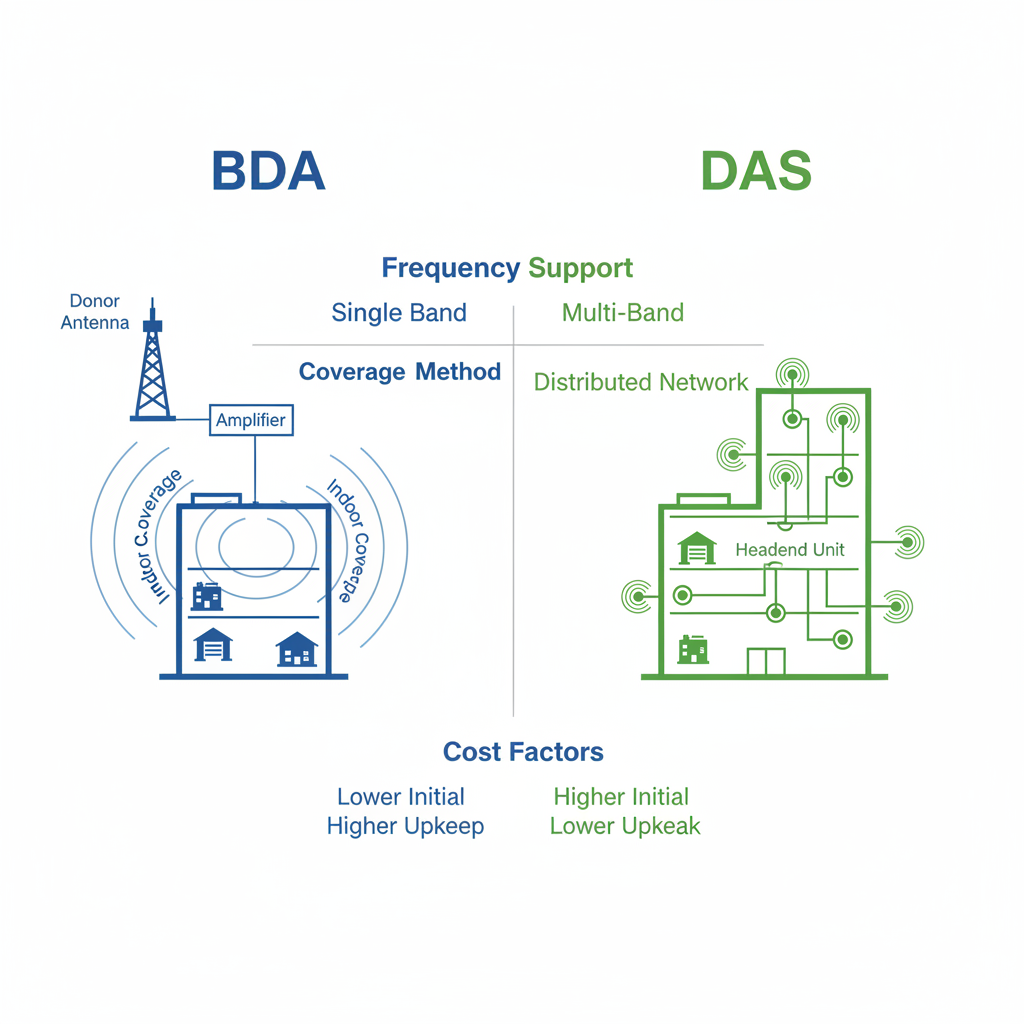
Comparison of BDA and DAS systems for enhanced building communications
For public safety DAS installation Idaho, ERCES testing evaluates coverage, ensuring at least 95% signal strength in critical areas like stairwells, aligning with state mandates for commercial buildings.
Integration with Fire Alarm Standards
BDA and DAS systems integrate seamlessly with fire alarm frameworks under NFPA 72 codes, which mandate monitoring to detect faults like low signal or power loss. This connection triggers alarms if communication coverage drops below standards, safeguarding occupants during emergencies.
The interface typically involves dedicated monitoring panels linked to the fire control system, relaying status via dry contacts or digital signals. For BDA, UL2524 compliance requires automatic shutdown on failure, while DAS extends this to broader networks. In Idaho Falls facilities, this ensures bi-directional amplifiers and distributed antennas alert responders to issues, such as amplifier overload, preventing communication blackouts.
- Monitoring Interface: Connects to fire panel for real-time status.
- Alarm Triggers: Activates on signal degradation or equipment fault.
- Compliance Testing: Verifies integration per local codes.
Public safety DAS installation Idaho often includes bda das verification through ERCES processes, confirming NFPA adherence and addressing queries on whether BDA falls under fire alarm oversight. This foundational integration paves the way for exploring tangible benefits in safety and efficiency.
Key Advantages of In-Building Signal Boosters
In-building signal boosters like bi-directional amplifiers (BDA) and distributed antenna systems (DAS) deliver essential connectivity in Idaho Falls structures. These systems address signal challenges in large facilities, enhancing safety and efficiency for building owners. By focusing on public safety, regulatory adherence, and daily operations, they provide clear value through reliable coverage.
Improving Public Safety Response Times
BDA and DAS systems ensure first responders maintain clear radio communications during emergencies, significantly cutting response delays. In critical situations, such as fires in high-rise buildings or industrial sites, these boosters amplify signals to penetrate thick walls and eliminate interference. This reliability allows firefighters and EMS teams to coordinate effectively, reducing evacuation times and saving lives.
Evidence from safety studies shows response times improved by up to 50 percent with proper signal amplifier installation, as highlighted in ERS Wireless analyses. For instance, in a simulated hospital scenario, DAS prevented signal drops that could otherwise extend rescue efforts by minutes.
Locally in Idaho Falls, White Cloud Communications integrates these systems into municipal buildings and healthcare facilities, aligning with southeastern Idaho’s unique terrain challenges. Their expertise ensures seamless deployment for faster public safety outcomes.
The following table compares key benefits of implementing BDA/DAS versus operating without them:
| Aspect | With BDA/DAS | Without |
|---|---|---|
| Response Time | Reduced by 30-50% | Delayed signals risk lives |
| Compliance | NFPA/UL certified | Fines up to $50K |
| Operations | No dead zones | Frequent disruptions |
This overview underscores the urgency: without boosters, delays can escalate risks, while certified systems like those from White Cloud mitigate them effectively, per NFPA 72 standards and Idaho code examples.
Ensuring Regulatory Compliance Benefits
Meeting Idaho fire codes becomes straightforward with BDA and DAS, avoiding hefty fines through consistent signal coverage and mandatory ERCES testing. These systems comply with NFPA 72 and UL 2524 standards, verifying that emergency signals reach all areas of a building. Building owners gain peace of mind knowing inspections pass without issues, preventing operational shutdowns.
The Signal Booster Idaho ERRC resource notes that non-compliance in the Northwest can lead to penalties exceeding $50,000, but reliable DAS installations reduce this risk substantially. Local case studies demonstrate how annual testing maintains certification, as seen in compliant industrial plants.
In Idaho Falls, White Cloud handles public safety DAS installation Idaho requirements, supporting mining operations and government sites. Their local presence in southeastern Idaho ensures tailored solutions that meet state mandates efficiently.
- Fine Avoidance: Save thousands annually on penalties.
- Inspection Readiness: Automated testing simplifies audits.
- Long-Term Assurance: Certified setups last for years with minimal upkeep.
Enhancing Operational Efficiency
BDA and DAS eliminate dead zones, boosting daily operations in commercial and industrial settings by providing uninterrupted coverage. Workers in warehouses or campuses communicate seamlessly, minimizing downtime from signal failures. This leads to smoother workflows and reduced need for bi-directional amplifier troubleshooting, as systems run reliably.
Integration with standards like TETRA and land mobile radio (LMR) extends benefits, supporting digital mobile radio for versatile applications. In a Boise-area factory example, DAS removed coverage gaps, cutting communication errors by 40 percent and enhancing productivity.
For Idaho Falls businesses, a BDA DAS system in Idaho Falls addresses signal enhancement advantages in facilities like hospitals and logistics hubs. White Cloud’s tower network and 24/7 support deliver in-building coverage perks, tailored to local industries such as mining and transportation.
- Dead Zone Removal: Full facility connectivity improves coordination.
- Cost Savings: Less downtime equals higher output.
- Scalable Integration: Works with existing LMR setups for future-proofing.
The Mechanics of BDA and DAS Installations
Bi-directional amplifiers (BDAs) and distributed antenna systems (DAS) form the backbone of reliable in-building radio coverage, especially in Idaho Falls structures where signal penetration challenges arise from thick walls and remote locations. These systems amplify and distribute public safety signals to eliminate dead zones, ensuring first responders maintain clear communication during emergencies. Understanding their mechanics reveals how they achieve seamless distributed coverage tech across commercial and public buildings.
Core Components and Signal Flow
BDAs and DAS rely on key hardware to capture, boost, and rebroadcast signals effectively. A donor antenna positioned outside the building receives external radio signal pathways from cell towers or radio networks. This signal feeds into a bi-directional amplifier, which strengthens it for indoor use while allowing two-way communication. In DAS setups, the amplified signal splits across multiple antennas for uniform distribution.
The building antenna signal booster plays a crucial role here, capturing faint outdoor signals and converting them into robust indoor transmissions. Indoors, radiating cables or antennas rebroadcast the enhanced signal, creating consistent coverage. For BDA, the process follows a simple flow: Signal in → Amplify → Distribute. DAS expands this with a network of nodes, splitting the signal to cover larger areas without hotspots or drops.
To illustrate differences, the following table compares operational aspects under NFPA guidelines and Idaho examples:
| Component | BDA Function | DAS Function |
|---|---|---|
| Amplifier | Bi-directional boost | Signal splitting |
| Antennas | Targeted indoors | Distributed network |
| Testing | UL2524 focus | ERCES coverage |
This comparison highlights BDA’s focused amplification versus DAS’s expansive reach, both vital for public safety in southeastern Idaho. Benefits include reduced signal loss and faster response times, with troubleshooting addressing common issues like low donor input.
Installation Process in Idaho Buildings
Installing a BDA DAS system in Idaho Falls demands precision to meet local codes and ensure public safety DAS installation Idaho standards. Certified technicians from providers like White Cloud begin with site surveys, mapping building layouts and signal strengths using spectrum analyzers. Next, they design the system layout, selecting components suited to the structure’s size and materials.
Cabling follows, routing coaxial or fiber lines from the donor antenna to indoor distribution points. Technicians mount antennas strategically to avoid interference. The process includes numbered steps: 1) Conduct RF survey to identify weak spots; 2) Install donor and indoor antennas; 3) Connect and configure amplifiers; 4) Run cabling through conduits. Commissioning involves ERCES testing, verifying signal levels exceed 95 dB for fire and police radios per Idaho Falls requirements.
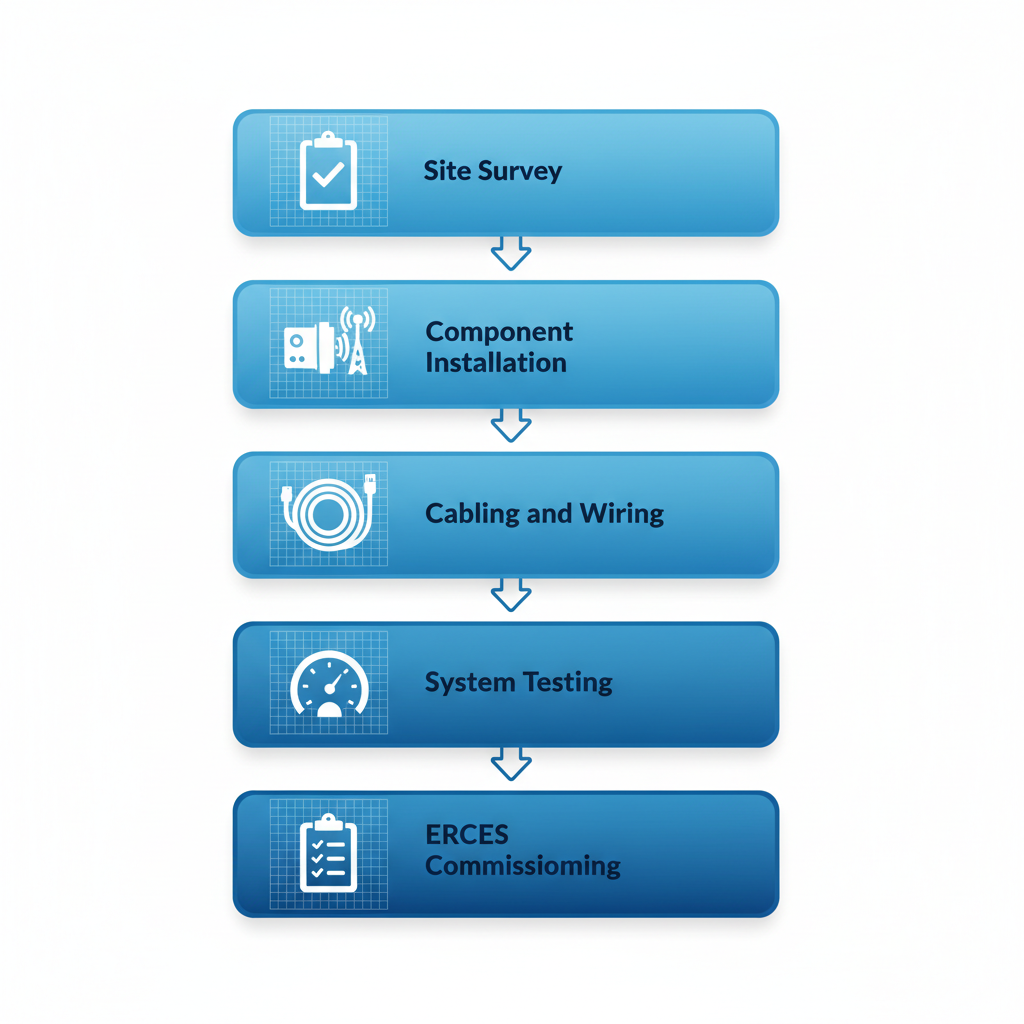
Step-by-step BDA and DAS system installation process in Idaho
White Cloud’s 24/7 support ensures smooth execution, with ERCES procedures confirming compliance through simulated emergency tests. This workflow demystifies installations, addressing questions on ERCES for commercial buildings by integrating local adaptations like tower-linked coverage.
Integration with Existing Systems
Seamlessly connecting BDAs and DAS to building infrastructure enhances overall functionality beyond standalone use. These systems link to fire alarms for automatic activation during emergencies, triggering signal boosts when alarms sound. Integration with motorola radios and other devices follows P25 and TETRA standards, ensuring compatibility with digital voice and data protocols.
Network ties allow monitoring via building management systems, with Ethernet or serial connections for remote diagnostics. For radio systems, BDAs amplify P25 trunked signals from Motorola portables, maintaining encryption and priority access. The flow integrates as: Alarm trigger → System activation → Signal enhancement → Radio dispatch.
Troubleshooting bi-directional amplifier troubleshooting covers alarms from overloads or faults, often resolved by checking power supplies or antenna alignments. Contrary to misconceptions, these setups support daily operations, not just fires, by interfacing with security networks. White Cloud’s certified processes in Idaho Falls deliver reliable ties, previewing maintenance for sustained performance and code adherence.
Optimizing and Maintaining Your BDA System
Maintaining your BDA and DAS systems ensures reliable public safety communications in Idaho Falls buildings. Regular upkeep prevents downtime and complies with local regulations, protecting lives and operations. Focus on structured testing, quick fixes, and professional support to maximize performance.
Routine Testing and Compliance Checks
Routine testing keeps your BDA system compliant with Idaho standards, avoiding fines and ensuring emergency responders stay connected. Start with monthly visual inspections to check for visible damage, loose connections, or environmental issues like dust buildup on antennas. These simple checks, as recommended by NFPA 72, allow early detection of potential problems.
For comprehensive assurance, schedule annual ERCES testing conducted by certified professionals. This involves full signal strength measurements, donor antenna verification, and documentation submission to local authorities. ERCES procedures confirm UL 2524 compliance, verifying coverage across all building areas. Document every test with detailed reports, including dates, results, and technician signatures, to maintain audit-ready records.
The following table outlines a practical maintenance schedule:
| Frequency | Task | Benefit |
|---|---|---|
| Monthly | Visual Inspection | Early Issue Detection |
| Annually | ERCES Test | Full Compliance |
| As Needed | Troubleshoot Alarms | Minimize Downtime |
Supported by NFPA 72 and UL 2524 standards, this schedule promotes proactive care. Tip: Partner with local experts like White Cloud for efficient testing in Idaho Falls facilities. Warning: Skipping annual tests risks non-compliance and signal blackouts during crises–always prioritize certified services over DIY attempts.
Troubleshooting Common Issues
Common BDA issues in Idaho Falls, such as signal failures or alarms, can disrupt critical communications, but systematic bi-directional amplifier troubleshooting resolves them efficiently. Begin by identifying the alert type: low signal often stems from antenna misalignment, while overheating may indicate poor ventilation or faulty components.
Follow these numbered steps for diagnosis: 1. Power down the system safely and inspect donor and service antennas for obstructions or shifts, common in industrial sites exposed to weather. 2. Use a signal meter to measure RSSI levels; values below -80 dBm signal weakness requiring recalibration. 3. Check bi-directional amplifier connections and clean filters to eliminate interference from nearby electronics. 4. For radio-specific problems, test with Digital Uhf Radios to isolate device faults. 5. Restart and retest coverage, logging findings for compliance.
In local settings, environmental factors like building materials amplify issues, so involve experts early. Tip: Keep a troubleshooting log to track patterns and speed future fixes. Warning: Avoid unauthorized tampering, as it voids warranties and endangers public safety–contact professionals for complex signal booster maintenance in public safety DAS installation Idaho environments.
Best Practices for Long-Term Performance
Sustain your BDA DAS system in Idaho Falls through strategic upkeep, ensuring decades of reliable service. Opt for annual service contracts with providers like White Cloud, who offer 24/7 support and tailored plans for Northwest installations, costing $10,000 to $50,000 based on building size.
Implement these best practices: 1. Schedule bi-annual firmware updates to enhance compatibility with evolving two-way radios. 2. Conduct quarterly signal surveys to adapt to structural changes, like expansions in healthcare or manufacturing facilities. 3. Integrate system upkeep strategies, including backup power checks and spare parts inventory, to prevent outages.
White Cloud’s Idaho Falls team excels in ongoing signal booster maintenance, providing site-specific advice and rapid response. These measures boost efficiency and longevity. Tip: Budget for professional audits to optimize costs and performance. Warning: Neglecting updates can lead to obsolescence and regulatory violations–rely on local expertise for enduring functionality.
Achieving Compliance with Local Experts
In summary, BDA and DAS systems are vital for eliminating dead zones in Idaho Falls buildings, ensuring seamless radio coverage and adherence to Idaho public safety standards. These technologies amplify first responder signals, enhancing emergency response times and overall safety through bi-directional amplifiers and distributed antenna networks. By integrating What Are Radio Repeaters Idaho Falls for wide-area support, building owners can achieve reliable in-building communications that meet NFPA 72 and UL 2524 requirements, as validated by local compliance guides showing up to 99% signal improvement in similar installations.
For expert implementation, partner with White Cloud Communications, a trusted provider with over 50 years of experience and a dedicated Idaho Falls office. Their specialists excel in P25 and LMR technologies, offering comprehensive FCC licensing, system design, and maintenance services tailored to public safety DAS installation in Idaho. Whether troubleshooting bi-directional amplifiers or conducting site surveys, White Cloud’s certified technicians deliver turnkey solutions that remove connectivity barriers and ensure long-term reliability.
Take the first step toward compliance today. Partner with White Cloud for your BDA DAS system in Idaho Falls needs–contact them at 208-733-5470 or [email protected] for a free consultation and build a safer future for your facility.