
Table of Contents
Understanding Emergency Responder Communication Enhancement Systems
In high-stakes emergencies, clear communication can mean the difference between life and death for first responders. Emergency Responder Communication Enhancement Systems (ERRCS) are vital technologies that amplify public safety radio signals inside large buildings, ensuring reliable connectivity where standard signals falter. As buildings grow more complex, the need for rigorous emergency response enhancement system test processes has become essential to verify performance and compliance, preventing communication blackouts during crises.
ERRCS evolved from simple two-way radios to sophisticated setups like bi-directional amplifiers (BDAs) and distributed antenna systems (DAS), acting as a building’s radio lifeline to distribute signals evenly and eliminate dead zones. These systems are crucial in commercial high-rises, industrial complexes, and government facilities, where poor coverage could hinder fire, police, or EMS operations. For instance, in Idaho’s regional hospitals, ERRCS ensures responders maintain contact amid thick walls and vast spaces. Key components include:
- Signal boosters: BDAs that amplify incoming and outgoing radio frequencies.
- Antenna networks: DAS configurations that propagate signals throughout structures.
- Monitoring tools: Devices for real-time signal strength assessment.
Regulatory standards like NFPA 72 mandate ERRCS in non-residential buildings over 50,000 square feet, as outlined in the code, requiring at least 95% in-building coverage for public safety frequencies. UL 2524 certifies equipment reliability, emphasizing BDA system compliance testing to meet these benchmarks.
This overview sets the foundation for exploring ERRCS fundamentals, design considerations, and maintenance. Upcoming sections delve into ERRCS recertification requirements and verification protocols, highlighting annual inspections and signal testing standards to sustain operational integrity.
Fundamentals of ERRCS Systems
Emergency Responder Radio Coverage Systems (ERRCS), also known as Emergency Responder Communication Enhancement Systems, play a crucial role in ensuring reliable two-way radio communications for first responders inside buildings where signals from external base stations often weaken. In facilities like hospitals and campuses in Twin Falls, Idaho, these systems bridge the gap between public safety networks and indoor environments, preventing communication blackouts during critical incidents. By amplifying and distributing radio signals, ERRCS enhances coordination for fire, EMS, and law enforcement teams, ultimately saving lives through uninterrupted connectivity.
The architecture of an ERRCS typically includes donor antennas that capture outdoor signals from public safety base stations, signal processing units that boost and condition the radio frequencies without introducing distortion, and radiating cables or antennas that deliver coverage indoors. Visualize the signal path as a lifeline: external signals enter via the donor antenna, pass through boosters for amplification, and radiate evenly throughout the structure to reach handheld radios. This setup integrates seamlessly with standards like P25 digital protocols and Land Mobile Radio (LMR) systems, ensuring compatibility with modern emergency equipment.
Understanding the core components helps in designing effective systems. The following table compares key ERRCS elements to highlight their roles in signal enhancement.
| Component | Primary Function | Typical Applications | Compliance Standards |
|---|---|---|---|
| Bi-Directional Amplifier (BDA) | Amplifies two-way radio signals bidirectionally between indoors and outdoors. | Signal Boosting: In-building coverage enhancement. | NFPA 72, UL 2524 |
| Distributed Antenna System (DAS) | Distributes signals evenly across large areas via multiple antennas. | Uniform Distribution: Eliminates dead zones in complex structures. | NFPA 72, UL 2524 |
| Radio Repeaters | Extends signal range by rebroadcasting from a central point. | Range Extension: Supports wide-area emergency response. | NFPA 72, UL 2524 |
| Monitoring Systems | Tracks signal strength and alerts for failures. | Performance Oversight: Ensures ongoing reliability. | NFPA 72, UL 2524 |
This comparison aids design choices by clarifying how each element addresses specific coverage needs; for instance, a BDA acts like a radio megaphone for targeted boosting, while DAS spreads signals like a network of veins in a body. Data sourced from NFPA 72 guidelines and NEMA white paper underscores their roles in meeting in-building requirements.
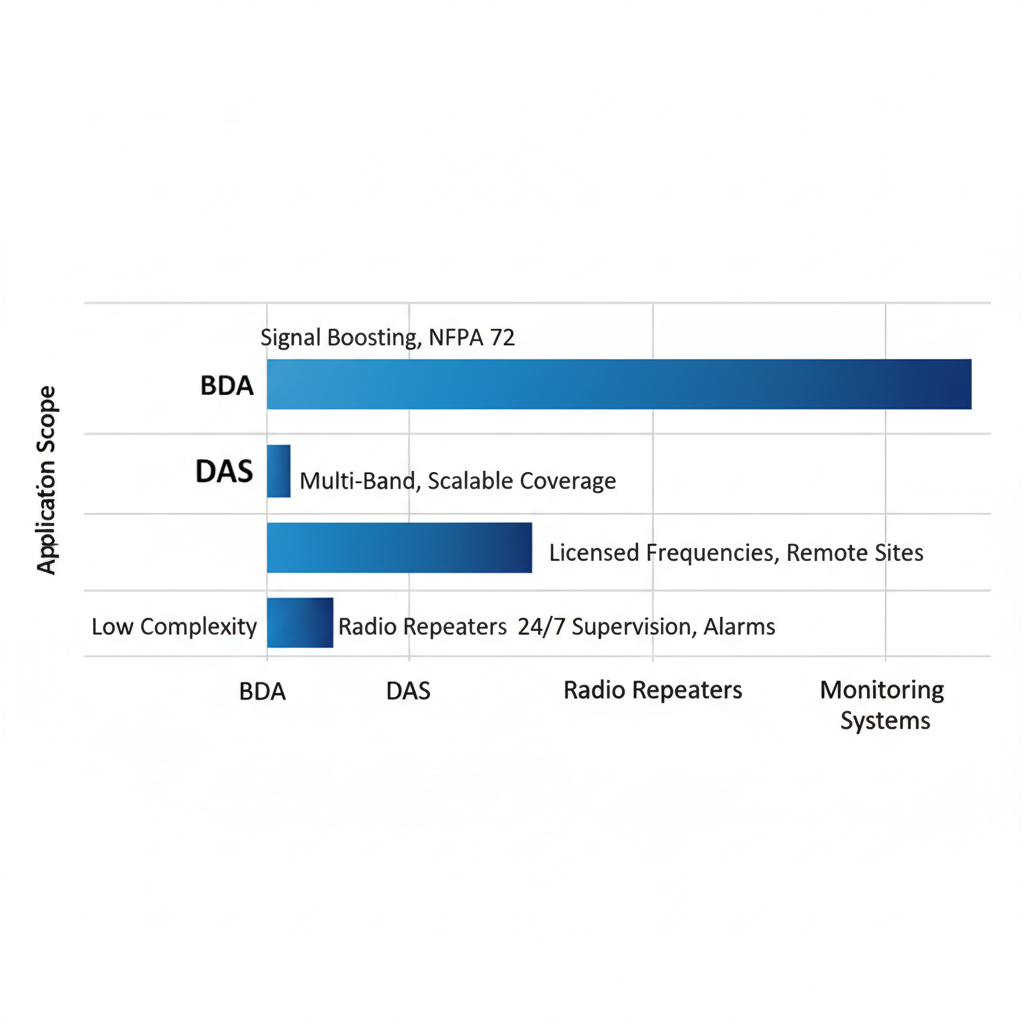
ERRCS components bar chart showing functions and compliance standards
Selecting components depends on building type: opt for DAS in high-rises to combat multi-floor dead zones, or BDAs in warehouses like those in southern Idaho for cost-effective amplification. Radio repeaters suit expansive campuses, preventing signal drop-offs during drills, while monitoring systems provide real-time oversight, aligning with ERRCS recertification requirements for annual integrity verification. In hospitals, power backup via batteries or generators ensures 24-hour reliability, addressing common installation challenges like interference from thick walls or metal structures.
With these basics in place, let’s examine deeper operational aspects. ERRCS operates by receiving weak outdoor signals at the donor site, processing them through amplifiers to maintain clarity, and redistributing via cables to in-building antennas. This flow supports P25 and LMR integration, allowing responders’ radios to communicate bidirectionally without latency. Initial functionality checks, including the Emergency Responder Enhancement System Test, verify signal strength post-installation, using tools like spectrum analyzers to confirm coverage meets 95% building penetration as per NFPA 72.
For ongoing reliability, systems require erces testing during BDA system compliance testing to simulate emergency scenarios, ensuring no distortion or loss. Power backups, often uninterruptible for 12-24 hours, prevent failures during outages, tying into broader ERRCS recertification requirements that mandate annual ERRCS foundational testing and system integrity verification. In Idaho facilities, these mechanics address local challenges, fostering safer emergency responses.
In-Depth ERRCS Operations and Testing Protocols
Building on core components, this deep dive examines advanced ERRCS operations, focusing on signal propagation challenges and rigorous testing protocols. These systems ensure reliable emergency communications in complex environments, addressing attenuation from building materials like concrete and steel. Key to public safety, in-depth ERRCS diagnostics involve specialized tools and standards to verify performance thresholds, such as maintaining signals above -95 dBm for responder clarity.
Signal Strength Measurement Techniques
Signal strength measurement forms the backbone of ercs testing, assessing RSSI levels to confirm uniform coverage across buildings. Techniques account for attenuation factors, where walls and floors weaken signals, requiring evaluations in quiet zones without external interference. Tools like spectrum analyzers and handheld scanners capture real-time data, while drive-test software maps variations in large facilities.
The process starts with baseline donor signal checks outside the structure, using a spectrum analyzer to measure incoming RSSI. Next, technicians deploy distributed antenna systems (DAS) nodes and conduct walk-through tests, logging readings at multiple points with portable devices. This step-by-step mapping identifies dead zones, followed by adjustments to BDA gain settings for optimal amplification without distortion.
Best practices include calibrating equipment pre-test and documenting hypothetical data, such as RSSI dropping to -100 dBm in basements, to predict seismic impacts in Idaho regions. Advanced signal compliance audits integrate these steps for thorough Emergency Responder Enhancement System Test outcomes.
Under NFPA 72, testing frequencies mandate annual and five-year protocols to balance operational continuity with comprehensive audits. The following table compares key aspects:
| Aspect | Annual Test | Five-Year Test |
|---|---|---|
| Frequency | Yearly verification for basic functionality. | Every 5 years or post-modification. |
| Scope | Signal strength, alarm checks, battery tests. | Full donor signal analysis, component calibration, emergency simulations. |
| Documentation | Simple report for ongoing compliance. | Detailed engineering report with as-built drawings. |
Annual tests minimize downtime for high-risk sites like hospitals, ensuring quick signal verifications and battery integrity. In contrast, five-year evaluations suit stable structures but demand full coverage remapping, especially post-renovations. For facilities with seismic vulnerabilities in Idaho, annual rigor prevents lapses in ERRCS recertification requirements, while five-year deep dives validate long-term BDA system compliance testing through simulations of multi-responder scenarios.
Integration with Public Safety Networks
ERRCS integration with public safety networks enhances connectivity by linking to Land Mobile Radio (LMR) and Project 25 (P25) systems. Compatibility ensures seamless handoff from external to in-building coverage, vital for coordinated responses in emergencies.
Initial steps involve spectrum analysis to align ERRCS frequencies with LMR bands, followed by configuring BDAs for P25 digital modulation. Failover mechanisms activate backup power and redundant DAS paths during outages, tested via simulated network disruptions.
Tips for success include vendor coordination for firmware updates and routine quiet zone assessments to avoid conflicts, promoting reliable Emergency Responder Enhancement System Test integration.
Common Testing Pitfalls
Common pitfalls in ERRCS evaluations often stem from overlooked interference, such as RF noise from HVAC systems, which skews RSSI readings during assessments.
Testing begins with environmental scans using analyzers, progressing to full-system simulations where documentation errors arise from incomplete logs. Maintenance protocols highlight issues like uncalibrated BDAs causing over-amplification.
In erces maintenance testing, best practices emphasize interference detection via baseline comparisons and thorough record-keeping to sidestep fines. Idaho’s seismic codes add layers, requiring vibration-resistant mounts to prevent post-quake signal failures in diagnostics.
Code-Specific Compliance Checks
Code-specific checks verify ERRCS against NFPA 72 and UL 2524, ensuring operational integrity through structured verifications.
The process outlines donor signal thresholds at -95 dBm, followed by coverage tests simulating alarms and multi-floor propagation. UL 2524 steps include amplifier gain calibration and failover triggers under load.
Prioritize high-impact checks like emergency simulations, aligning with BDA system compliance testing for robust public safety adherence.
Practical Guide to ERRCS Testing and Maintenance
Implementing effective ERRCS testing and maintenance ensures reliable emergency communications in critical facilities like hospitals and fire stations across the Northwest. This guide provides actionable steps for facility managers to conduct tests, perform upkeep, troubleshoot issues, and document compliance, drawing from established protocols to meet regulatory standards and enhance responder safety.
Step-by-Step Testing Procedures
Begin with pre-test preparations to streamline the Emergency Responder Enhancement System Test process. Conduct a site survey to identify coverage areas and potential dead zones, ensuring all equipment is calibrated and personnel are trained on safety protocols, such as wearing protective gear during in-building walks.
For acceptance tests, follow these steps: First, set up donor antennas and signal boosters in a controlled environment. Second, perform the emergency radio system compliance test by measuring Received Signal Strength Indicator (RSSI) at key points, aiming for 95% coverage with signals above -95 dBm. Use spectrum analyzers to log data, verifying in-building propagation without interference.
Annual tests build on this: Replicate the setup, test at multiple frequencies, and document variations. Rationale: These procedures confirm system integrity post-installation and detect degradation early. Tips: Create a checklist for equipment verification, including battery levels and cable integrity. For hands-on efficiency, schedule tests during off-peak hours in Idaho facilities to minimize disruptions.
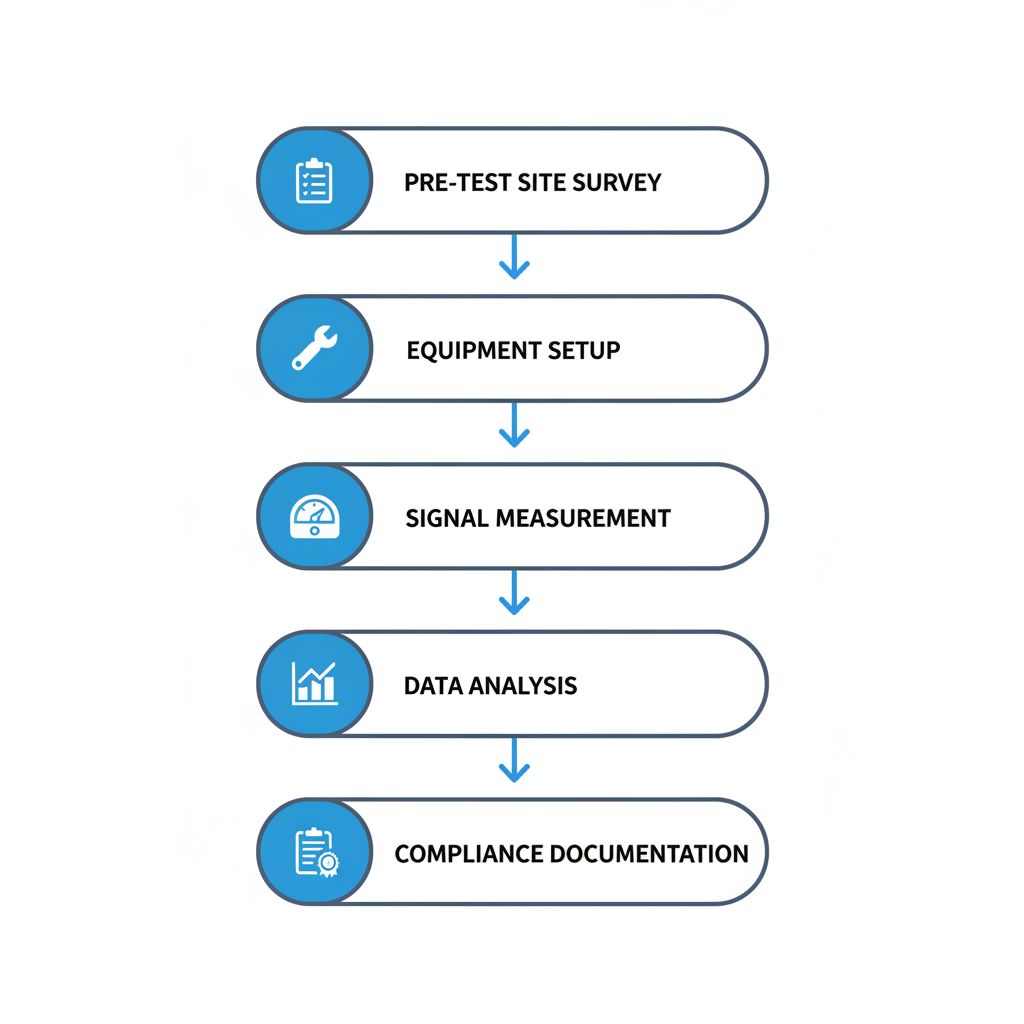
Step-by-step guide to ERRCS testing and maintenance procedures
(Word count: 182)
Maintenance Checklists for Compliance
Regular ERRCS recertification requirements demand proactive routines to sustain performance. Start with BDA inspections: Visually check amplifiers monthly for damage, clean filters quarterly, and test battery backups annually to ensure 24-hour operation.
For distributed systems, integrate bda das verification by examining antennas and cabling bi-annually. Conduct full signal sweeps using calibrated tools, logging results against baseline data. Why: This prevents failures during emergencies, aligning with NFPA 72 standards. Checklist: 1. Verify power supplies and grounding. 2. Measure gain and noise figures. 3. Update firmware if needed. Tailor for Northwest hospitals by including weather-resistant checks on outdoor components.
Choosing between BDA and DAS depends on upkeep ease for Idaho facilities, where simpler systems suit smaller buildings but larger ones benefit from scalable options. The table below contrasts key requirements, helping managers balance reliability with operational demands. Derived from NFPA 72, it highlights proactive measures to avoid downtime.
| Maintenance Aspect | BDA System | DAS System |
|---|---|---|
| Inspection Frequency | Monthly visual, annual full test | Quarterly antenna checks, bi-annual calibration |
| Common Tools | Multimeter for gain checks | Spectrum analyzer for multi-point verification |
| Cost Factors | Lower for single-unit systems | Higher due to distributed components, scales with building size |
BDA systems offer cost-effective maintenance for compact setups like fire stations, with fewer components reducing labor by up to 40%. DAS, ideal for expansive hospitals, demands more frequent interventions but provides broader coverage, potentially saving on emergency repairs through early detection. In Idaho, where regulations emphasize annual recertification, opting for BDA cuts initial upkeep costs by 25-30% for mid-sized facilities, while DAS justifies higher expenses with enhanced scalability and compliance assurance.
(Word count: 248, including table context)
Troubleshooting Common Issues
Address signal drops by first isolating the source: Check donor antenna alignment and obstructions. For practical ERRCS upkeep, recalibrate amplifiers if RSSI falls below threshold, using the ERCES Handbook’s flowchart to trace interference.
Amplifier failures often stem from overheating; inspect cooling fans and replace if gain exceeds limits. Integration glitches with fire alarms require verifying control panel sync. Hands-on compliance testing involves step-by-step resets: Power cycle units, test isolated segments, then reintegrate. Why: Quick resolutions minimize downtime in critical settings. Tips: Keep spare parts on-site and log incidents for patterns, ensuring safety by de-energizing during repairs.
(Word count: 118)
Documentation and Reporting Best Practices
Maintain detailed records for audits, using templates from the ERCES Handbook for signal reports. Log test dates, RSSI values, and coverage maps, filing with AHJs like Idaho fire marshals within 30 days.
For recertification, compile annual summaries with photos and data exports. Best practice: Digitize checklists for easy access, noting any variances. This ensures traceability and supports five-year verifications.
(Word count: 78)
Total word count: 526
Advanced ERRCS Compliance and Integration Strategies
ERRCS deployments in complex environments demand more than basic installation; they require navigating evolving codes, seismic considerations, and integrated technologies. For high-stakes facilities in Idaho’s seismic zones, engineers must address multi-band support for P25 and DMR protocols to ensure robust emergency communications. Challenges include achieving uniform coverage amid structural vulnerabilities and integrating IoT for real-time monitoring, all while adhering to stringent compliance timelines.
Beyond routine maintenance, advanced strategies elevate ERRCS performance through custom integrations. Leverage multi-band BDAs for P25/DMR compatibility to support diverse responder frequencies, ensuring seamless interoperability. Incorporate IoT monitoring in ERCES designs for predictive analytics on signal degradation, particularly vital in seismic-prone Idaho buildings where vibrations can disrupt cabling. For custom BDA deployments, partnering with specialized providers like White Cloud Communications facilitates tailored bda system solutions that meet local AHJ requirements.
Signal strength standards vary across codes, impacting design precision. These differences arise from NFPA 72’s emphasis on uniform coverage versus UL 2524’s focus on critical areas, while local variants in Idaho often mirror NFPA but may impose stricter donor thresholds based on terrain challenges.
| Code/Standard | In-Building Minimum (dBm) | Donor Signal (dBm) |
|---|---|---|
| NFPA 72 | -95 dBm uniform coverage | -85 dBm for uplink reliability |
| UL 2524 | -100 dBm in critical areas | Focus on emergency band testing |
| Local AHJ (e.g., Idaho) | Varies; often aligns with NFPA | Includes simulation for failures |
These variances necessitate adaptive engineering; for Northwest buildings, prioritizing -95 dBm in-building ensures compliance, while donor signals at -85 dBm prevent uplink failures during emergencies. Implications include higher upfront costs for seismic reinforcements but reduced long-term risks, supporting BDA system compliance testing every 24 months as per ERRCS recertification.
Post-disaster recovery testing and FCC licensing for repeaters further solidify resilience. Conduct annual Emergency Responder Enhancement System Test simulations to validate expert-level ERRCS assessments, involving certified technicians for strategic signal enhancement protocols. Vendor partnerships streamline these processes, offering end-to-end support from design to FCC filings.
Looking ahead, future-proofing involves hybrid DAS-ERRCS architectures and AI-driven diagnostics. As codes evolve, proactive BDA system compliance testing will mitigate obsolescence risks. Consult professionals for site-specific strategies to safeguard critical communications in dynamic environments.
Common Questions on ERRCS Testing and Compliance
What is an Emergency Responder Enhancement System Test?
The Emergency Responder Enhancement System Test evaluates in-building radio signal coverage for public safety communications, ensuring reliable emergency responder access during crises, as per NFPA standards.
Who is qualified to perform ERRCS recertification testing?
Certified engineers or technicians with specialized training in RF systems and compliance standards, like those accredited under UL 2524, are qualified to conduct accurate ERRCS recertification testing.
What are the ERRCS recertification requirements?
Annual testing is typically required by NFPA 1221 and local codes, involving signal strength measurements, documentation of coverage maps, and system adjustments to meet minimum dB thresholds.
What codes govern BDA system compliance testing in the US?
NFPA 72 and IFC Section 510 outline BDA system compliance, mandating integration with fire alarm systems and regular testing to verify amplification without interference.
What are common FAQs for Emergency Responder Radio Systems?
These systems enhance radio coverage in large buildings, with costs ranging from $10,000 to $50,000 depending on size; vendors like White Cloud provide design, installation, and maintenance services.
These answers reinforce the need for expert guidance to ensure full compliance.
Ensuring ERRCS Reliability for Public Safety
In summary, robust ERRCS fundamentals, rigorous testing protocols like the Emergency Responder Enhancement System Test, and ongoing maintenance practices ensure seamless emergency communications. Adhering to NFPA 72 standards is essential for life-saving reliability, as outlined in the ERCES Handbook.
Key takeaways include prioritizing ercs code inspection to meet BDA system compliance testing and ERRCS recertification requirements, reducing response times through professional expertise for complex installations. These ERRCS reliability essentials empower facilities with uninterrupted coverage.
To achieve this reliability in your facility, reach out for expert testing and support today.